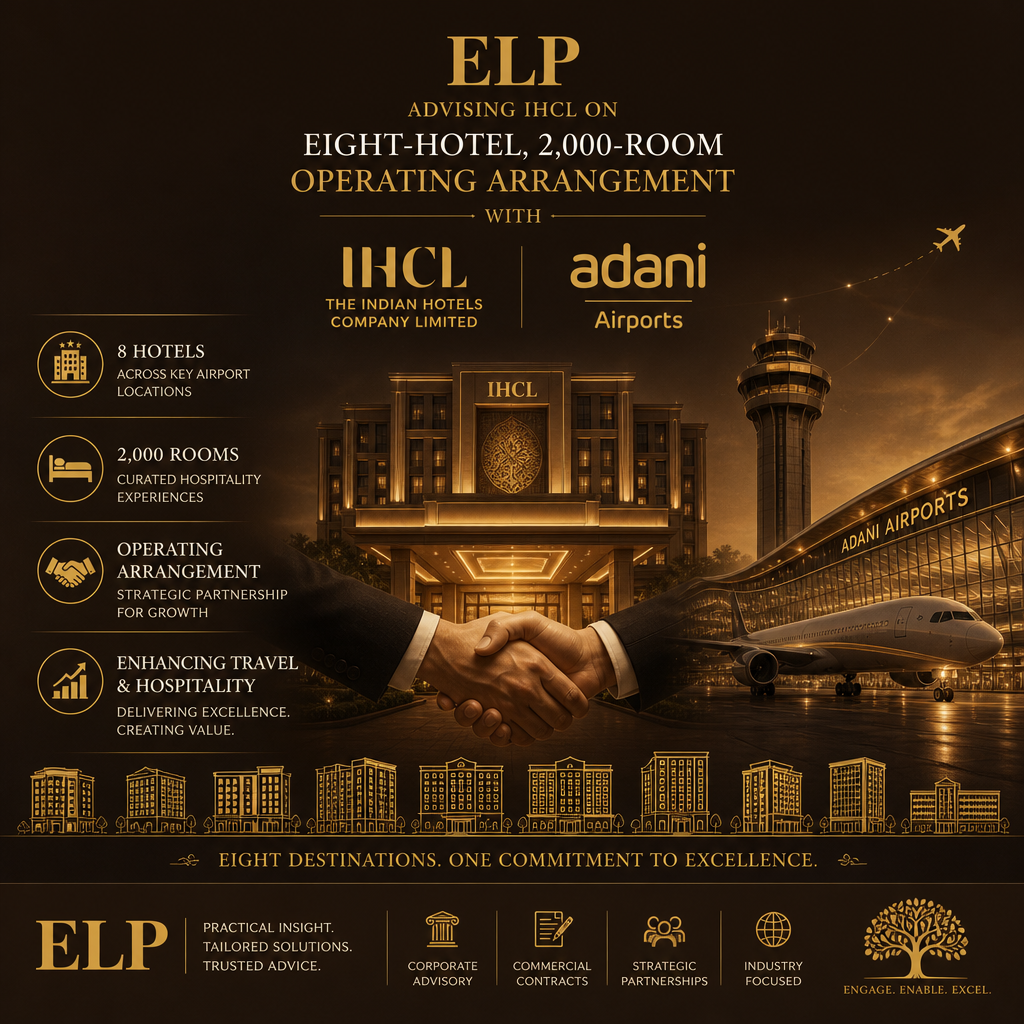
The Indian Hotels Company Limited (IHCL) has entered into an operating arrangement with Adani Airport Holdings Limited (AAHL) covering eight hotels and more than 2,000 rooms across four cities. Economic Laws Practice (ELP) advised IHCL on structuring the arrangement and negotiating the agreements governing the properties.
The mandate covered hotel management agreements and technical services agreements for hotels in Mumbai, Ahmedabad, Lucknow and Guwahati. Sujjain Talwar, Co-Founding Partner at ELP, led the transaction team, supported by Senior Associate Kriti Bhattacharya and Associate Aayush Bhattacharya.
The commercial division is between development and operations: Adani Airports will develop the hotels, while IHCL will operate them under the Taj, Vivanta, Gateway and Ginger brands. The portfolio spans luxury, upscale and midscale accommodation, rather than a single hotel category.
The arrangement also sits within Adani Airports’ broader Airport City strategy, which envisages mixed-use districts combining hospitality, business, retail and leisure. The disclosed legal mandate concerns that commercial operating structure, not an acquisition, merger or announced equity investment between the parties.
Key Highlights
Eight-property mandate: ELP advised IHCL on transaction structuring and drafted and negotiated hotel management and technical services agreements for all eight hotels.
Development and operations separated: AAHL will develop the properties; IHCL will operate them across four hospitality brands.
Four-city portfolio: Mumbai, Ahmedabad, Lucknow and Guwahati account for more than 2,000 rooms, with no property-wise room inventory disclosed.
Partner-led team: Sujjain Talwar led ELP’s team, assisted by Kriti Bhattacharya and Aayush Bhattacharya.
Commercial terms remain undisclosed: The available announcement does not set out management fees, contractual tenure, termination rights or binding completion deadlines.
ELP advises IHCL on operating arrangement covering eight hotels across four cities
ELP’s advisory role extended beyond documenting a single hotel-management mandate. The firm advised on the transaction’s structure and drafted and negotiated both categories of agreements across the eight-property portfolio, according to the legal-adviser announcement reported by Bar & Bench on 27 November 2026.
The transaction description accompanying the announcement states:
“The Firm advised on the transaction’s structuring and drafted and negotiated the hotel management agreements and technical services agreements for all eight hotels.”
That scope places the mandate at the interface between property development and hospitality operations. The agreements provide the contractual framework through which a developer’s projects are to become hotels operated under another company’s brands, although their detailed provisions have not been published.
The chronology requires care. Commercial reports appeared on 29 October 2026, while IHCL’s investor-relations announcement displays 26 November 2026 and the legal-adviser report followed on 27 November. The available material does not explain the discrepancy, so none of these publication dates should automatically be treated as the date on which the agreements were executed.
How development and hotel operations are divided between Adani Airports and IHCL
The announced allocation is straightforward: AAHL is responsible for developing the hotels, and IHCL will operate them. This distinction matters because the development of a hospitality asset and the management of its day-to-day business involve different responsibilities, expenditure and commercial risks.
At a general level, hotel-development arrangements must connect construction and delivery with the requirements of the intended operator. Decisions concerning design, facilities and readiness for opening can affect how a hotel functions once guests arrive. The disclosed transaction documents address management and technical services, but their precise division of obligations is not public.
The announcement does not establish that IHCL is acquiring the underlying properties or taking an equity stake in AAHL. Equally, the description of AAHL as developer does not disclose the property-holding structure, financing arrangements or any project-level entities involved. Those details cannot be inferred from the operating mandate alone.
The portfolio includes properties at different stages, from construction to greenfield development. Implementation will therefore involve a progression from development to operational readiness, rather than the simultaneous transfer of eight functioning hotels. The public material does not specify whether openings will occur in a particular contractual sequence.
Taj, Vivanta, Gateway and Ginger brands span more than 2,000 rooms
The portfolio comprises three Taj hotels, two Vivanta hotels, one Gateway hotel and two Ginger hotels. Together, they represent more than 2,000 rooms across the luxury, upscale and midscale segments, allowing the arrangement to address different accommodation requirements within airport-linked locations.
IHCL Managing Director and Chief Executive Officer Puneet Chhatwal placed the additions within the company’s wider airport portfolio:
“With these additions, IHCL will have 25 hotels across its brandscape at key airports in India.”
The figure of 25 describes IHCL’s airport-linked presence with these additions; it is not the number of hotels covered by this transaction. Likewise, the aggregate room figure does not reveal how capacity will be distributed between the four brands or the individual cities.
Chhatwal’s broader remarks connected aviation growth with the emergence of airport-centred hospitality and commercial hubs. The announced hotels are intended to offer dining, meetings and events, wellness and recreational facilities alongside accommodation. That wider offering positions them for uses beyond an overnight stay, although no individual property’s detailed facilities schedule has been disclosed.
The eight-property portfolio across Mumbai, Ahmedabad, Lucknow and Guwahati
Mumbai accounts for one Taj hotel, reported to be under construction at Terminal 2 of Mumbai airport. Ahmedabad will have one Taj and one Vivanta, both described in a 30 October 2026 report by The Times of India as being at advanced stages of construction.
Lucknow accounts for one Vivanta and one Ginger. Guwahati has the largest allocation by hotel count, with one Taj, one Gateway and one Ginger. These city-wise allocations add up to the eight properties covered by the announced arrangement.
Business Standard, attributing its information to people familiar with the details, reported that construction had begun for the Mumbai, Lucknow and Ahmedabad hotels. It also reported an expectation that most properties would become operational in three to four years. That is a reported development expectation, not a published contractual deadline or a confirmed opening date for every hotel.
The geographical boundaries are important. Navi Mumbai and Jaipur feature in the broader Airport City programme, but neither is identified as an additional location within this eight-hotel allocation. Nor does the available material provide a room count for each property, making any city-wise capacity estimate speculative.
Hotel management and technical services agreements underpin the arrangement
The two disclosed categories of documents are hotel management agreements and technical services agreements. Their identification provides the clearest indication of the legal architecture: an operating relationship supported by arrangements relevant to bringing the properties into the intended hospitality format.
In general commercial practice, a hotel management agreement sets out the relationship between the property-side party and the operator. Matters commonly addressed include operational responsibilities, budgeting, reporting, remuneration and contractual remedies. These are contextual features of such agreements, not confirmed terms of the IHCL-AAHL documents.
Technical services agreements generally concern specialist input associated with developing or preparing a hotel for operation. Depending on their terms, they can address the interface between a proposed property and an operator’s requirements. The announcement does not disclose the actual services, approval mechanisms, delivery standards or liability allocation negotiated here.
No agreement text, governing-law provision, arbitration clause or regulatory approval is identified in the available deal report. Accordingly, the announcement does not support a conclusion about particular competition, securities, foreign-exchange or airport-concession requirements. Identifying the contractual instruments is different from establishing that any specific statutory approval was required, obtained or waived.
Sujjain Talwar leads ELP team advising IHCL on the transaction
Sujjain Talwar, Co-Founding Partner at ELP, led the transaction. The reported supporting team comprised Kriti Bhattacharya, Senior Associate, and Aayush Bhattacharya, Associate. ELP’s own indexed announcement gives the senior associate’s fuller name as Kriti Gautam Bhattacharya.
The disclosed mandate combines structuring advice with drafting and negotiation. Those are related but distinct parts of transactional work: the structure establishes the broad commercial relationship, while the documents translate it into obligations, procedures and remedies that the parties can administer over time.
For a portfolio spanning four brands and different development stages, documentation must accommodate both the common relationship and property-specific requirements. The public report confirms that ELP advised across all eight hotels, but does not say whether the documentation used a master framework, separate standalone contracts or a combination of instruments.
The available report identifies ELP as counsel to IHCL only. It does not name AAHL’s external legal advisers, disclose an in-house legal team or allocate individual drafting responsibilities among ELP’s lawyers. The confirmed representation should therefore not be extended beyond the named client and team.
Airport City strategy places hotels within broader mixed-use districts
The hotels form part of a broader strategy to develop airport-linked districts rather than treat airports solely as transport infrastructure. AAHL Director Jeet Adani described the approach in these terms:
“Across the world, leading airports are evolving into integrated destinations that serve as catalysts for commerce, tourism and urban growth.”
AAHL formed Adani Airport City Limited to develop a land bank exceeding 655 acres across six airports in five states, including nearly 440 acres in Mumbai and Navi Mumbai. The wider programme combines hospitality with business, retail, leisure and other visitor infrastructure.
The announced first phase envisages investment exceeding ₹20,000 crore and approximately 22 million square feet across Mumbai, Navi Mumbai, Ahmedabad, Lucknow, Jaipur and Guwahati. These figures describe the broader Airport City programme. They are not a disclosed valuation, development cost or investment commitment attributable exclusively to the eight IHCL hotels.
The distinction between the wider development platform and this operating arrangement is central to assessing the announcement. The hotel agreements constitute one component of a larger mixed-use strategy; the material does not establish that IHCL is responsible for developing, financing or operating the surrounding commercial districts.
What the announcement does not disclose on fees, tenure or completion timelines
The announcement leaves several commercially significant terms outside the public domain. These include management fees, agreement tenure, termination rights, conditions precedent and transaction consideration. Without those provisions, the financial value of the operating mandate and the parties’ detailed allocation of risk cannot be independently assessed.
There is also no disclosed, binding portfolio-wide completion schedule. Reported expectations of openings within three to four years should remain separate from contractual obligations, particularly where projects are at different stages. The unexplained difference between the October reports and the November investor-relations date similarly prevents a definitive statement about execution timing.
The confirmed outcome is therefore an announced eight-hotel operating arrangement, supported by management and technical services documentation, with development and subsequent operations still to be implemented across the portfolio. Further disclosures would be needed to establish individual opening dates, final room inventories and the commercial terms governing each property.
Legal representation: IHCL was advised by Economic Laws Practice, with Co-Founding Partner Sujjain Talwar leading the team, supported by Senior Associate Kriti Bhattacharya and Associate Aayush Bhattacharya. AAHL’s external counsel was not identified in the available deal report.
Sources