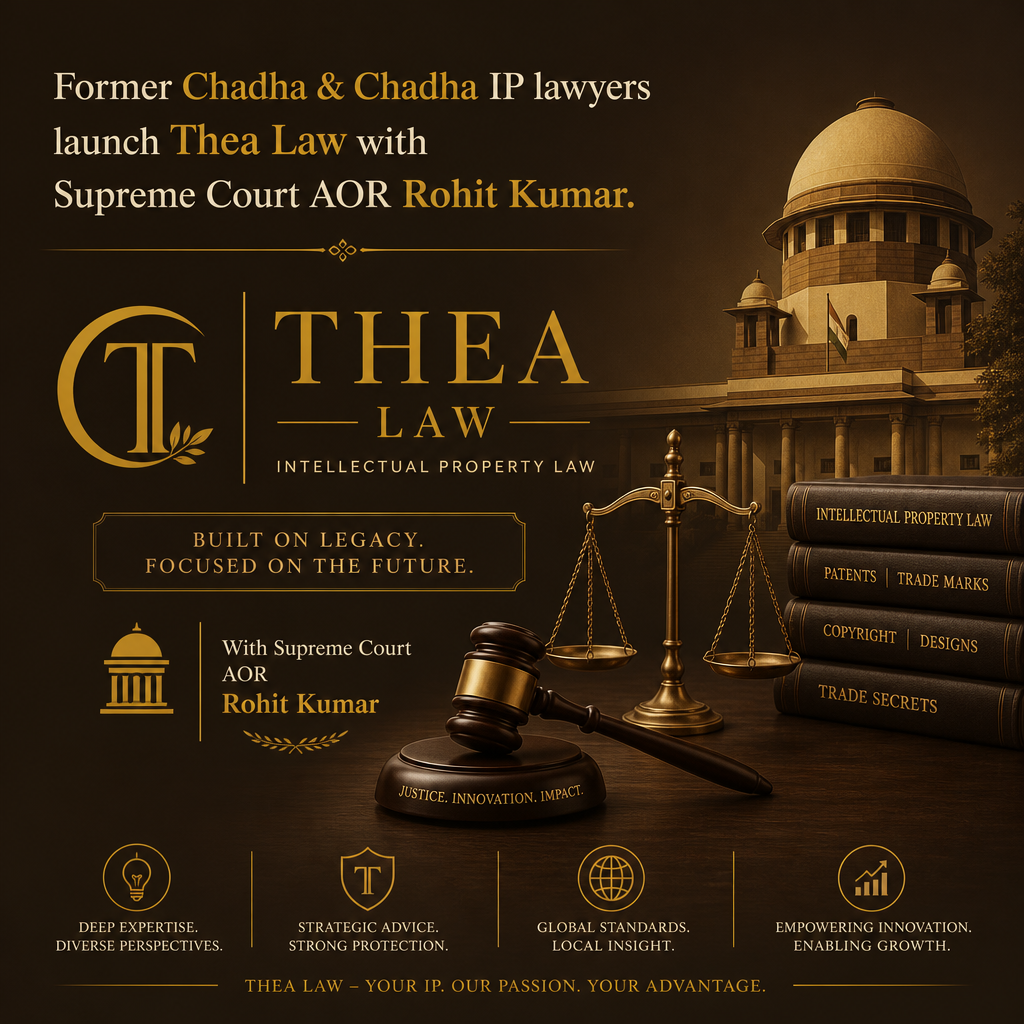
Former Chadha & Chadha IP lawyers Drsika Bhutani and Rupali Gujral have launched Thea Law, a Delhi-based firm, with Supreme Court Advocate-on-Record Rohit Kumar-I joining as partner. The firm plans a multidisciplinary practice covering intellectual property, litigation, corporate advisory, regulatory matters and dispute resolution.
Bhutani and Gujral each bring over three years of experience across transactional, prosecution, commercial IP and data privacy matters. Kumar brings more than 13 years at the Bar, with a practice spanning constitutional and commercial litigation, arbitration, mediation, technology law and public policy.
The launch brings together lawyers with backgrounds in specialist IP practice, constitutional court litigation and technology-sector legal work. Their stated objective is to serve businesses, institutions, entrepreneurs and individuals across both established practice areas and fields where legal and regulatory frameworks continue to develop.
The proposed offering extends beyond business advisory to employment, workplace compliance, family law, succession and estate planning. Construction and energy-related contracts and disputes will also form part of the firm's focus.
Key Highlights
Delhi launch: Former Chadha & Chadha IP lawyers Drsika Bhutani and Rupali Gujral have established Thea Law, with Rohit Kumar-I joining as partner.
Supreme Court capability: Kumar is an Advocate-on-Record with more than 13 years of experience at the Bar, including constitutional and commercial litigation and domestic and international dispute resolution.
IP and technology experience: Bhutani and Gujral bring transactional, prosecution, commercial IP and data privacy experience. Kumar has worked with legal teams at ByteDance, Google and Snapchat.
Broad practice plans: The firm's services span commercial contracts, regulatory advisory, employment compliance, arbitration, family matters and estate planning.
Emerging regulation: The founders intend to combine conventional legal services with advisory work in areas where legal frameworks are still evolving.
Thea Law's launch marks Bhutani and Gujral's move from a specialist intellectual property practice to building a firm with a wider advisory and disputes offering. Both previously worked at Chadha & Chadha IP, and their experience forms the intellectual property component of the new practice.
The Delhi-based firm brings together three advocates whose professional backgrounds cover different stages of a legal matter, from structuring commercial relationships and protecting rights to advising on compliance and resolving disputes. Its announced scope includes support for businesses throughout their operational and contractual lifecycle.
That approach treats legal work as an ongoing part of business operations rather than only a response to litigation. Contract negotiation, rights protection, workplace policies and regulatory decisions can each influence the disputes a business eventually faces, making coordination between advisory and contentious work important.
Explaining the proposed positioning, the founders said:
“Thea Law seeks to position itself as a contemporary legal practice capable of addressing both conventional legal requirements and newer areas where the regulatory and legal frameworks continue to evolve.”
The announcement sets out the firm's intended breadth. It does not identify a particular mandate or dispute accompanying the launch, with the emphasis instead on the team's experience and the services it proposes to develop.
Rohit Kumar joins as partner, bringing more than 13 years at the Bar
Rohit Kumar-I, an alumnus of the Faculty of Law, University of Delhi, joins as partner with over 13 years of experience at the Bar. An Advocate-on-Record at the Supreme Court of India, he brings experience in litigation before constitutional courts and in domestic and international dispute resolution.
The Advocate-on-Record designation carries a specific procedural role in Supreme Court practice. Advocates-on-Record are authorised to act and file on behalf of parties before the Court, a function distinct from appearing to argue a matter. The role therefore involves responsibility for the conduct of proceedings as well as familiarity with the Court's procedural requirements.
Kumar's practice spans constitutional and commercial litigation, arbitration, mediation, regulatory and technology law, and public policy. These fields involve different forms of legal problem-solving: constitutional litigation can concern public power and rights, while commercial proceedings generally centre on business obligations, contractual entitlements and remedies.
He has also worked with the legal teams of ByteDance, Google and Snapchat. That experience adds exposure to the intersection of technology, business and regulation. Alongside his litigation background, his practice encompasses corporate advisory, emerging regulatory issues and complex commercial disputes, broadening the firm's proposed offering beyond IP-focused work.
Bhutani and Gujral bring IP, transactional and data privacy experience
Drsika Bhutani is an alumna of JGLS, O.P. Jindal Global University, while Rupali Gujral graduated from the Faculty of Law, University of Delhi. Both previously practised at Chadha & Chadha IP and have each accumulated more than three years of experience across transactional, prosecution, commercial IP and data privacy matters.
Those areas represent distinct, but connected, aspects of intellectual property practice. Prosecution work concerns pursuing applications and navigating the process through which rights are examined and registered. Transactional and commercial IP work concerns how rights are licensed, transferred, used and protected within business relationships.
The distinction matters because obtaining a right and commercially exploiting it raise different questions. A business may need advice not only on protection, but also on ownership, permitted use, confidentiality, contractual restrictions and the allocation of responsibility when a relationship ends or a dispute arises.
Data privacy work adds another dimension to that experience. Personal-data obligations are distinct from intellectual property rights, even where both arise within the same product, service or commercial arrangement. For a multidisciplinary practice, the ability to distinguish these issues while assessing their combined effect is relevant to drafting contracts, reviewing operations and advising on risk.
The firm's planned services span commercial contracts, compliance and disputes
Thea Law plans to provide drafting, vetting and negotiation of commercial agreements, alongside contract management and regulatory advisory. Its stated services also include representation in commercial disputes, arbitration and other dispute resolution proceedings, linking front-end advisory work with the enforcement of contractual rights.
Each stage serves a different purpose. Drafting records the parties' intended obligations; vetting tests the proposed allocation of risk; and negotiation addresses differences before commitments become binding. Contract management then concerns how those commitments are administered, including performance requirements, notices, changes, renewals and termination.
Dispute resolution becomes relevant when those arrangements break down or their meaning is contested. Arbitration depends on a valid agreement to submit disputes to that process, while mediation seeks a negotiated resolution rather than an adjudicated outcome. The appropriate route depends on the agreement, the applicable law, the relief sought and the circumstances of the dispute.
The founders linked the proposed service offering to changing client requirements:
“As clients navigate a fast-changing legal and regulatory landscape, we want to be the team they turn to, including in newer areas where the law is still taking shape.”
The firm's planned regulatory advisory work sits alongside these contractual services. Commercial arrangements must operate within applicable legal requirements, and a contract cannot by itself remove statutory obligations or resolve uncertainty about the regulatory treatment of an activity.
Employment, POSH, family and estate matters round out the practice
The firm's announced employment practice includes advice on employment documentation, workplace policies, compliance frameworks and Prevention of Sexual Harassment (POSH) policies. These services concern both the terms governing individual employment relationships and the systems through which an organisation manages workplace obligations.
Employment documentation and internal policies perform related but different functions. An employment agreement records the terms of engagement, while workplace policies establish processes and expectations across an organisation. Effective compliance also requires implementation, appropriate complaint-handling procedures and attention to the legal requirements applicable to the workplace.
POSH work has a particular institutional dimension. A written policy is one component of workplace prevention and redressal, not a substitute for the mechanisms and procedures required under the applicable framework. Advice in this area must account for fair process, confidentiality and the responsibilities of those handling complaints.
Beyond employer advisory, Thea Law's announced services include family law, succession, inheritance and estate planning, including complex disputes involving high-net-worth individuals and families. These matters can combine questions of personal rights, ownership, family relationships and control over assets.
Estate planning is generally directed at organising affairs before a dispute or succession event, whereas inheritance litigation concerns contested entitlements. The applicable personal law, the nature of the property and the validity and effect of relevant documents can materially shape the advice required in an individual matter.
Construction and energy-related contracts and disputes are identified as additional focus areas for Thea Law. The announcement places these alongside emerging commercial and regulatory work, extending the firm's intended reach into sectors where contractual performance and regulatory requirements can be closely connected.
Construction contracts commonly require careful treatment of scope, payment, timelines, variations and responsibility for delay or defective performance. Disputes may involve competing accounts of project events, making contemporaneous records and compliance with contractual notice procedures important to the assessment of claims and defences.
Energy-related work can similarly require contractual advice to be read alongside sector-specific legal obligations. Depending on the transaction or project, questions of approvals, performance, supply arrangements and risk allocation may arise together. The firm's announcement does not identify a particular project, technology or energy subsector.
Emerging regulatory work presents a different challenge: distinguishing binding obligations from proposals, guidance and areas of unresolved interpretation. Clients need clarity not only about what the law requires, but also about where uncertainty remains and how it may affect a proposed course of action.
The team's combined experience in technology law, privacy, public policy, corporate advisory and disputes is relevant to that proposed focus. However, the announcement describes the firm's intended areas of practice rather than an established record of mandates undertaken under the new banner.
Founders position Thea Law as a contemporary, client-focused Indian firm
The founders have positioned Thea Law as part of a generation of Indian firms developing outside traditional set-ups. Their statement places emphasis on understanding client needs, communicating legal risk clearly and providing advice directed towards practical decisions.
“We are part of a new generation of emerging Indian law firms working outside traditional set-ups, offering legal excellence with a clear focus on understanding the client, advising plainly on risks and options, and delivering practical outcomes.”
That positioning draws together the different elements of the announced practice. A business may require IP protection, commercial documentation, privacy advice and dispute resolution within the same relationship. Individuals and families may likewise need coordinated advice where personal, property and business interests overlap.
The founders summarised the intended reach of the firm in their launch statement:
“With its combination of intellectual property expertise, Supreme Court litigation experience, corporate exposure, and dispute resolution capabilities, Thea Law aims to develop a multidisciplinary practice serving businesses, institutions, entrepreneurs and individuals in India and beyond.”
The immediate task is to build that multidisciplinary offering around the three lawyers' complementary experience. The announcement sets out a broad direction: combining conventional advisory and representation work with newer regulatory questions, while retaining an emphasis on clear advice about risks, available options and the legal consequences of business and personal decisions.