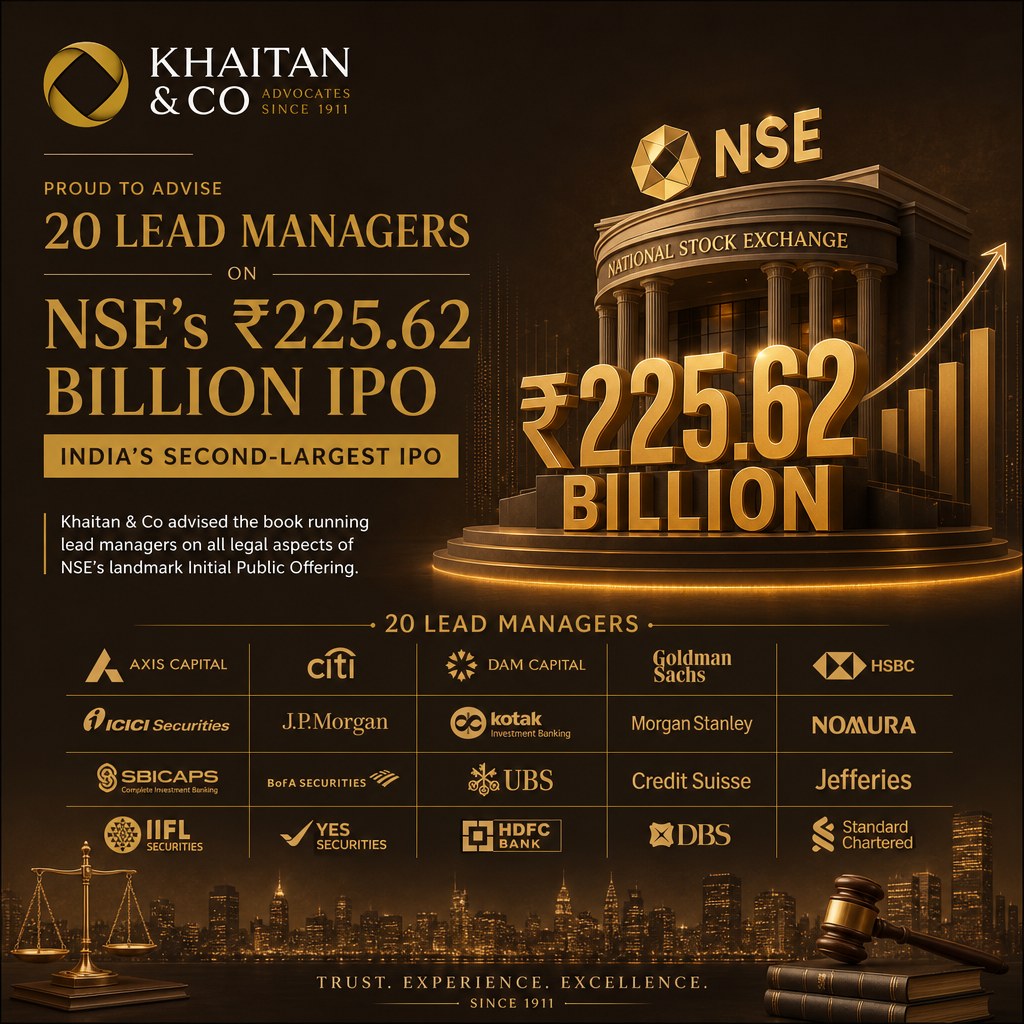
Khaitan & Co advised the 20 book running lead managers on the initial public offering of National Stock Exchange of India Limited (NSE), aggregating to ₹225.62 billion, or approximately ₹22,561.57 crore. The offering was described in the transaction account as India's second-largest IPO and the largest IPO undertaken by a stock exchange in Asia.
The firm's core capital markets team included Partners Thomas George and Nagashayana S, Executive Director Sudhir Bassi and Counsel Prathiksha Panduranga. Eight lawyers formed the core team, with another eight identified as providing assistance.
The transaction brought together 20 book running lead managers, or BRLMs, constituting what the account described as the largest lead-manager syndicate on an Indian IPO. Khaitan & Co's disclosed mandate was to advise these intermediaries, rather than to act as issuer counsel to NSE.
Beyond its size, the offering draws attention to the legal coordination involved when a market institution becomes the subject of a public offering. The disclosed details establish the value, advisory mandate and team composition, although they do not specify the offer structure, pricing, subscription figures or listing timetable.
Key Highlights
Offer value: The IPO aggregated to ₹225,615.74 million, equivalent to ₹22,561.574 crore and rounded to ₹225.62 billion.
Market standing: The transaction account identifies it as India's second-largest IPO and Asia's largest IPO by a stock exchange.
Record syndicate: Twenty institutions acted as BRLMs, described as the largest such syndicate on an Indian IPO.
Legal mandate: Khaitan & Co advised the lead managers. The disclosed mandate should not be conflated with representation of the issuer.
Team composition: The firm identified an eight-member core team and eight additional lawyers who assisted with the offering.
Khaitan & Co advises the book running lead managers on NSE's ₹225.62 billion IPO
Khaitan & Co's role was recorded in the transaction account published on October 30, 2026. The account stated:
"Khaitan & Co advised the BRLMs on the landmark Initial Public Offering of National Stock Exchange of India Limited aggregating to INR 225,615.74 million."
The precise amount is relevant because the ₹225.62 billion headline figure is a rounded expression of the disclosed aggregate. In Indian numbering, the offering amounted to ₹22,561.574 crore. That figure describes the size of the offering; it does not, by itself, establish how much money accrued to NSE.
An IPO may involve newly issued shares, shares sold by existing shareholders, or a combination of the two. The supplied account does not identify which structure applied here. It would therefore be inaccurate to describe the entire offer value as fresh capital raised by the exchange.
The distinction between issuer counsel and BRLM counsel is equally important. Lead managers perform transaction-management and diligence functions, while their legal advisers assist them in assessing documentation, disclosures and legal risks relevant to those responsibilities. The announcement confirms the advisory relationship, but does not itemise Khaitan & Co's workstreams or disclose the terms of its engagement.
The offering ranks as India's second-largest IPO and Asia's largest stock exchange listing
The offering's significance rests on two separate comparisons: its position within India's IPO market and its position among public offerings by stock exchanges in Asia. The transaction account described it as:
"the second largest IPO in India and the largest IPO undertaken by a stock exchange in Asia."
These are distinct measures. The first compares the offering with Indian IPOs across issuer categories. The second concerns stock exchanges within a regional market. Neither description should be extended into a claim that this was Asia's largest IPO across all sectors or the world's largest exchange offering.
The issuer's institutional character also matters. A stock exchange provides infrastructure through which securities are traded, while an IPO concerns investment in the company undertaking the offering. These are different relationships, even where the issuer itself operates a marketplace used by other listed companies and investors.
As general legal context, an exchange offering brings corporate disclosure considerations alongside questions about governance, operational resilience and regulatory responsibilities. The announcement does not explain how those matters were addressed in this transaction. Nor does it identify the trading venue, listing date or any transaction-specific regulatory conditions, so the reported size rankings should not be treated as evidence of those separate milestones.
A 20-member lead manager syndicate makes it the largest on an Indian IPO
The breadth of the intermediary group is another defining feature. Twenty institutions acted as BRLMs, bringing a substantial number of transaction participants within the mandate on which Khaitan & Co advised.
The account characterised the offering as being:
"led by the largest syndicate of BRLMs on an Indian IPO"
A syndicate of this size creates a coordination task distinct from the monetary scale of the issue. As a matter of transaction practice, participating institutions need consistent information, aligned documentation and a clear process for reviewing material developments. A larger group can increase the number of review channels, even where participants work from common documents.
BRLM counsel can assist with that process by helping address legal questions across the intermediary group. However, the presence of 20 lead managers does not establish that each held an identical allocation of responsibilities. The announcement does not disclose internal work divisions, commercial arrangements, underwriting commitments or the role of any particular institution in investor engagement.
The investment banks and financial institutions appointed as book running lead managers
The disclosed syndicate comprised the following 20 institutions. Their full names are material to the transaction record because the advisory mandate concerned the BRLM group collectively:
Kotak Mahindra Capital Company Limited;
JM Financial Limited;
Morgan Stanley India Company Private Limited;
Citigroup Global Markets India Private Limited;
HSBC Securities and Capital Markets (India) Private Limited;
J.P. Morgan India Private Limited;
SBI Capital Markets Limited;
Anand Rathi Advisors Limited;
Avendus Capital Private Limited;
Axis Capital Limited;
DAM Capital Advisors Limited;
Equirus Capital Limited;
HDFC Bank Limited;
ICICI Securities Limited;
IDBI Capital Markets & Securities Limited;
IIFL Capital Services Limited;
Motilal Oswal Investment Advisors Limited;
Nuvama Wealth Management Limited;
Pantomath Capital Advisors Private Limited; and
360 ONE WAM Limited.
The list brings together institutions operating under both Indian and international financial-services brands. The account identifies each as a book running lead manager, without assigning separate titles or indicating a hierarchy within the syndicate.
That limitation matters when assessing participation. Appointment as a BRLM does not, without further information, establish an institution's share of fees, distribution contribution or responsibility for any particular segment of the offering. The disclosed list establishes participation, not a league table of individual contributions.
Khaitan & Co's core capital markets team on the transaction
The firm's core team consisted of Thomas George and Nagashayana S, both Partners; Sudhir Bassi, Executive Director; and Prathiksha Panduranga, Counsel. They were joined by Jash Botadra and Aadhya Singh, both Senior Associates, and Shishir Mani Tripathi and Siddhil Shah, both Associates.
The eight-member composition spans partner, executive director, counsel, senior associate and associate designations. It identifies the lawyers credited with the core mandate, but does not specify which lawyer handled particular documents, diligence areas or interactions with the lead managers.
In capital markets work generally, legal teams must connect detailed document review with broader judgments about materiality and disclosure. Information gathered during diligence needs to be assessed for its significance to investors and reflected consistently across the relevant transaction documents.
Those general functions explain the importance of layered staffing on a substantial offering, but they should not be presented as a verified allocation of work in this case. The transaction account contains no individual comments from the lawyers, no description of negotiations and no account of legal issues resolved during execution.
Additional Khaitan & Co lawyers who assisted with the IPO
The core team received assistance from Madhur Kohli, Partner, and Tharun Vadlapatla, Senior Associate. Six Associates were also named: Varun M Nair, Rupa Veena S, Lakshmi Raj C, G R Shreya Shetty, Anveeksha Anand and Nayonika Chatterji.
These additional credits bring the total number of identified Khaitan & Co lawyers to 16. Across the core and assisting groups, the disclosed team comprised three Partners, one Executive Director, one Counsel, three Senior Associates and eight Associates.
The distinction between the core team and assisting lawyers records how the transaction announcement presented the firm's staffing. It does not establish the time spent by each person, the sequence in which they participated or the relative importance of their contributions.
For a transaction involving numerous intermediaries, support across multiple levels can help manage parallel document reviews and information requests. That is a general feature of large transactional assignments, not a disclosed explanation for this particular staffing arrangement. The announcement supplies names and designations, but no further breakdown of the assistance provided.
What the scale of the offering signals for India's capital markets
The combination of a ₹22,561.574 crore offering and a 20-member lead-manager syndicate places this transaction at a significant point in the disclosed Indian IPO record. Its reported rankings also distinguish between the scale of the issue itself and the scale of the intermediary group assembled around it.
For legal practitioners, the transaction illustrates the organisational demands associated with large public offerings. More participating institutions can mean more interfaces for reviewing disclosures and resolving comments. The central legal objective remains coherent, accurate documentation rather than simply accommodating a larger number of participants.
The offering's size does not, however, establish investor demand, pricing performance or post-listing returns. The account provides no subscription figures, investor-category allocations, final share price or trading data. Nor does a single transaction, however large, independently establish the direction of the wider IPO market.
No operative regulatory directions, pending proceedings or future timetable are set out in the supplied account. Further assessment of the offering's structure and outcome would require the relevant offer and listing disclosures. Legal representation: Khaitan & Co advised the 20 book running lead managers through the core and assisting teams identified above; the account does not identify separate counsel for NSE or other transaction participants.
Sources