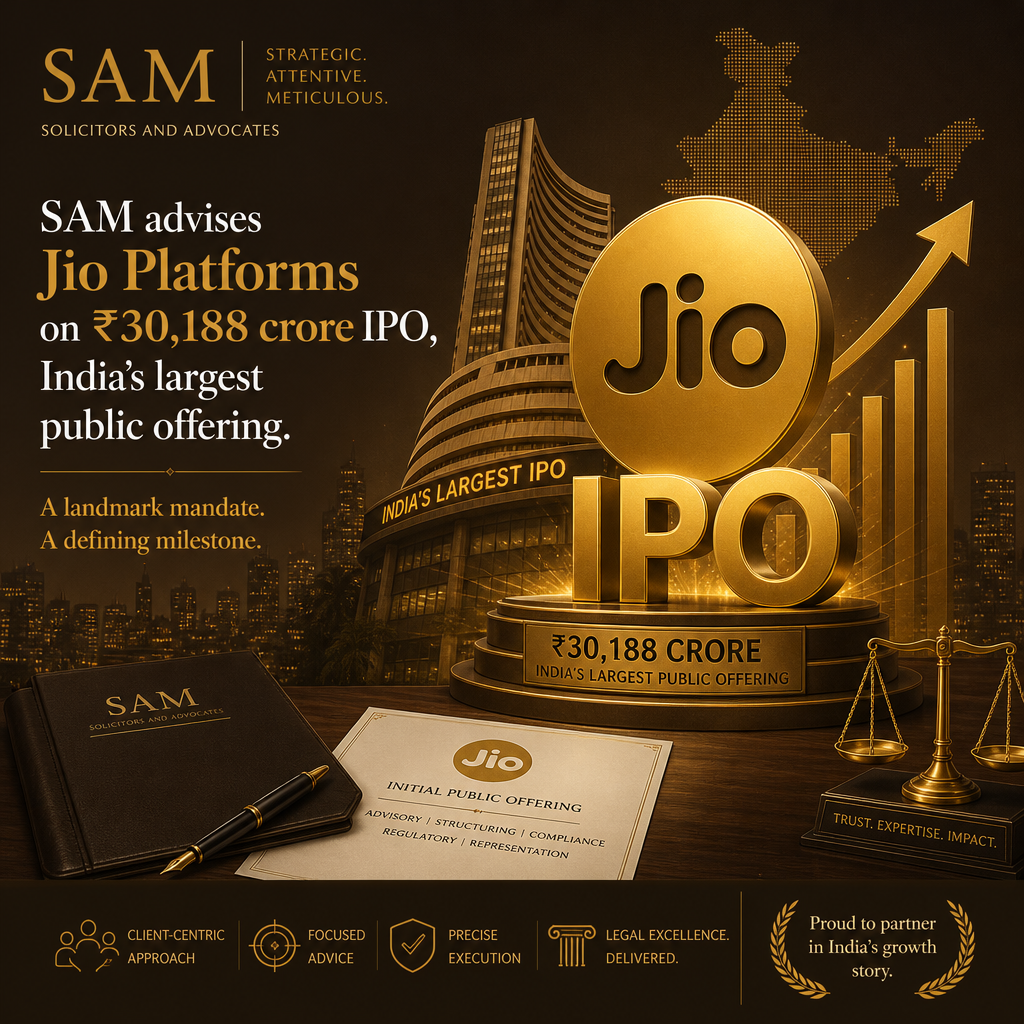
Shardul Amarchand Mangaldas & Co (SAM) advised Jio Platforms Limited as lead Indian law counsel on its ₹30,188 crore initial public offering (IPO), according to transaction details published on October 28. The offering surpassed Hyundai Motor India Limited’s ₹27,870 crore issue to become India’s largest IPO, the announcement said.
Jio Platforms, promoted by Reliance Industries Limited (RIL), offered a fresh issue of 27 crore equity shares. SAM’s transaction team was led by Partners Prashant Gupta and Nikhil Naredi, with Managing Partner Pallavi Shroff providing strategic inputs.
The reported investor response extended across institutional, non-institutional, retail and reserved categories. The qualified institutional buyer (QIB) portion was fully subscribed within 10 minutes of opening, while the overall offering reached full subscription within 100 minutes.
The transaction announcement also reported more than one crore applications and anchor investor bids approaching ₹2.5 lakh crore. These figures describe demand for the offering, rather than the amount ultimately raised or the number of investors allotted shares.
Key Highlights
Record offering: The ₹30,188 crore IPO exceeded Hyundai Motor India’s ₹27,870 crore issue, which SAM also advised on.
Rapid subscription: The QIB portion was fully subscribed within 10 minutes, and the overall IPO within 100 minutes of opening.
Anchor demand: The ₹8,110 crore anchor portion attracted approximately ₹2.5 lakh crore in bids and was subscribed more than 30 times.
Category-wise response: Overall subscription stood at 22.19 times, with the QIB portion drawing demand of 70.55 times.
Applications and advisory milestone: The announcement described the offering as the first IPO globally to receive over one crore applications. SAM said it has now advised on India’s five largest IPOs.
SAM acted as lead legal counsel to Jio Platforms on matters of Indian law for the offering, valued in the announcement at approximately $3.19 billion. The mandate places the firm on the issuer side of the transaction, advising the company raising capital rather than acting in a stated capacity for investors or intermediaries.
The distinction matters in a public offering involving several participants with separate responsibilities. Issuer counsel generally assists with legal due diligence, disclosure preparation, transaction documentation and compliance, while working alongside the company and other advisers. The announcement does not provide a task-by-task account of SAM’s mandate.
Describing the firm’s engagement, the transaction announcement stated that SAM advised:
“as the lead legal counsel to the Company as to Indian law”
Public offerings require disclosures that allow prospective investors to assess the issuer, its business and the risks attached to an investment. The reported scale of this transaction underscores the importance of that exercise, but does not itself establish anything about the investment’s merits or future performance. The announcement does not identify the offer’s risk factors or reproduce its disclosure documents.
Fresh issue of 27 crore shares puts the offering above Hyundai Motor India's record
The IPO comprised a fresh issue of 27 crore equity shares by Jio Platforms. At ₹30,188 crore, its reported size exceeded the ₹27,870 crore Hyundai Motor India offering by ₹2,318 crore. SAM advised on the Hyundai Motor India IPO as well, according to the announcement.
A fresh issue is distinct from an offer for sale. In a fresh issue, the company issues new shares to raise capital; an offer for sale involves existing shareholders selling their holdings. That distinction determines who receives the proceeds, subject to transaction expenses, and how the offering affects the company’s share capital.
Issuing additional equity also changes the denominator against which existing shareholders’ percentage holdings are measured. The precise ownership effect depends on the pre-issue capital structure and final allotment, neither of which is set out in the supplied transaction details.
The announcement does not specify the intended deployment of proceeds, the price band or a detailed capitalisation table. Accordingly, the offering’s size and fresh-issue structure should not be treated as evidence of any particular spending programme, valuation methodology or post-issue ownership percentage. Those questions require the relevant offer disclosures.
IPO fully subscribed in 100 minutes as QIB demand surged within 10
The announcement described an unusually swift build-up in demand after subscriptions opened. The QIB portion reached full subscription within 10 minutes, while bids sufficient to cover the overall IPO were received within 100 minutes. It characterised the offering as the fastest IPO on the reported subscription measures.
The transaction account recorded:
“the qualified institutional buyer portion of the IPO being fully subscribed within 10 minutes”
Full subscription means that demand has reached the quantity of shares available within the relevant portion or offering. It does not mean that bidding has closed, shares have been allotted or the issuer has completed all steps required for listing. Demand can continue accumulating after that threshold is crossed, as the final subscription figures here indicate.
The two time markers also measure different pools of demand: institutional participation and the offering as a whole. Their significance lies in the speed with which each threshold was reached, not in establishing identical participation across categories. The announcement does not supply an opening date, a bidding-day chronology or the methodology underlying its broader speed comparison.
Anchor investors bid nearly ₹2.5 lakh crore for the ₹8,110 crore portion
The ₹8,110 crore anchor investor portion attracted bids worth approximately ₹2.5 lakh crore, according to the transaction details. Subscription exceeded 30 times the available portion, which the announcement described as the highest-ever anchor investor demand for an Indian IPO.
Its account of the response stated that the anchor portion:
“was subscribed more than 30x and attracted bids worth approx. ₹ 2.5 Lakh crore”
Anchor participation is a distinct stage of the institutional investment process in a book-built public offering. It can provide an early indication of institutional interest, but demand expressed through bids must be distinguished from the allocation ultimately made. The reported ₹2.5 lakh crore therefore represents bidding interest, not an additional amount raised by Jio Platforms.
Anchor allocations operate within a regulated framework governing eligibility, allocation and holding restrictions. Strong demand does not remove those requirements or guarantee subsequent market performance. The announcement does not name the anchor investors, state their individual allocations or provide investor-level holding details, limiting the conclusions that can be drawn about the composition of that demand.
Offering oversubscribed 22.19 times, with QIB portion drawing 70.55 times demand
The final reported subscription multiple was 22.19 times for the overall offering. Institutional demand was the most pronounced category-level figure, with the QIB portion subscribed 70.55 times. The non-institutional investor portion recorded subscription of 14 times.
The retail investor portion was subscribed 2.72 times, while the employee reservation portion attracted demand of 2.93 times. The reservation for RIL shareholders was subscribed 7.60 times. Each reported category therefore received demand exceeding its available allocation, although the intensity differed substantially.
These multiples are measured against the shares available in the respective categories. They cannot simply be added together to derive the overall subscription figure, because each category has its own allocation base. Nor does a higher subscription multiple necessarily establish a larger absolute investment amount without knowing that base.
Oversubscription also requires a distinction between applications received and shares allotted. Investors cannot assume that the quantity sought will be allotted in full. The applicable allocation process, category eligibility and final basis of allotment govern the outcome. The announcement provides the demand figures, but not allotment ratios, rejected applications or the treatment of individual bids.
The transaction announcement made a separate claim about the breadth of participation: that the Jio Platforms offering was the first IPO globally to receive more than one crore applications. This is different from the records asserted for issue size, anchor demand and subscription speed.
The announcement stated:
“The IPO also became the first IPO globally to receive over 1 crore applications.”
An application count measures participation differently from a subscription multiple. A multiple captures demand relative to available shares, while an application count records the volume of applications submitted. Neither figure, without further information, establishes the number of unique beneficial investors or successful allottees.
Processing a large application volume places importance on validation, category classification, reconciliation and allotment administration. However, the supplied account does not describe those operational arrangements or identify the supporting dataset for its global comparison. The worldwide record is therefore reported as the announcement’s claim, rather than as an independently verified finding based on comparative exchange or regulatory records.
Prashant Gupta and Nikhil Naredi lead SAM's transaction team
Prashant Gupta and Nikhil Naredi, both Partners at SAM, led the transaction team. The disclosed team included lawyers at principal associate, senior associate and associate levels, reflecting a multi-level staffing structure for the issuer-side Indian law mandate.
Chinmay Sethia and Tarun Srikanth were named as Principal Associates. Shruthi Hariharan and Sridutt Mishra were the Senior Associates on the team. The Associates were Ankita Singh, Najeeb Din, Soundarya Mathavan and Aryan Singh.
Pallavi Shroff, identified as Managing Partner and National Practice Head - Dispute Resolution, provided strategic inputs to the transaction. The announcement does not elaborate on those inputs or allocate particular workstreams among the named lawyers.
Large public offerings typically require coordination across disclosure review, corporate records, diligence responses and documentation. Those are general features of issuer-side capital markets work, not a verified breakdown of individual responsibilities here. Shroff’s dispute resolution leadership designation should likewise not be read as indicating that the transaction involved litigation; no such proceedings are identified in the announcement.
SAM says it has advised on India's five largest IPOs
With the Jio Platforms mandate, SAM said it has advised on India’s five largest IPOs. The announcement expressly identifies Jio Platforms and Hyundai Motor India, but does not name the other three offerings or set out a full ranking of transactions supporting that statement.
The claim places this mandate within the firm’s broader capital markets practice. Experience on large offerings can involve managing extensive disclosures and coordinating several transaction participants. However, the size of previous mandates is not, by itself, a measure of investor outcomes, regulatory endorsement or the quality of any particular security.
The supplied account does not provide a listing date, listing-day performance or further post-offer steps. Subscription records should therefore remain separate from conclusions about trading performance or completion of subsequent formalities. The disclosed outcome is a record-sized offering with substantial reported demand, supported by an identified issuer-side Indian law team.
Counsel representation: Jio Platforms Limited was advised on Indian law by Shardul Amarchand Mangaldas & Co, led by Partners Prashant Gupta and Nikhil Naredi, with the associates and senior lawyers identified above. Pallavi Shroff provided strategic inputs.
Sources