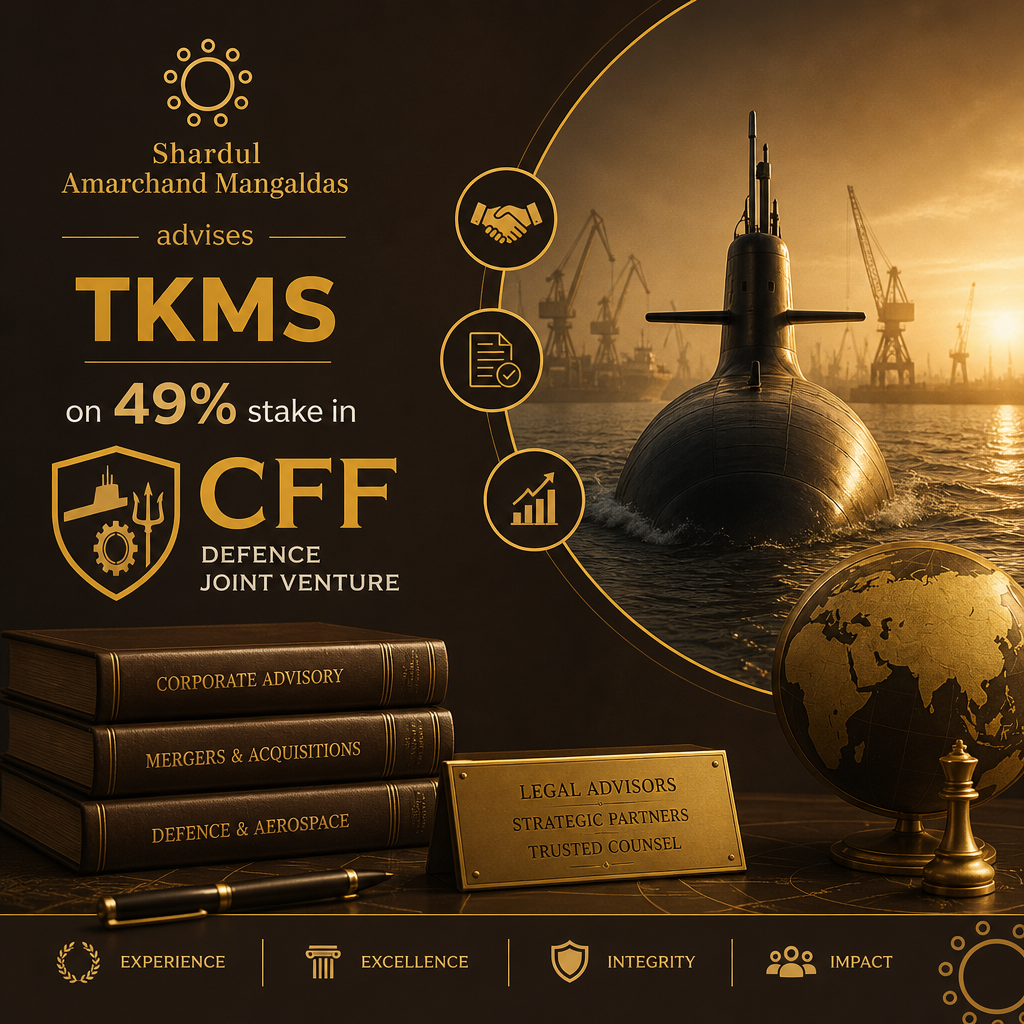
Shardul Amarchand Mangaldas & Co. (SAM) has advised TKMS ATLAS ELEKTRONIK GmbH on its joint venture agreement with CFF Fluid Control Limited to establish a defence company in India. CFF will hold 51% of the proposed company, while TKMS will hold the remaining 49%.
The venture will be named TKMS CFF Defence Systems Private Limited. SAM’s transaction team was led by Partners Alina Arora and Parth Singh, with a separate intellectual property team comprising Partners Dev Robinson and J.V. Abhay, among other lawyers.
The announcement, published on November 12, 2026, identifies the parties, the proposed ownership structure and the legal advisory teams. It does not disclose the transaction value, the partners’ capital commitments, the venture’s proposed product portfolio or a timetable for commencing operations.
The distinction between the joint venture agreement and the company’s establishment is important. The disclosure records advice on the agreement to establish the business; it does not separately confirm incorporation, completion of the investment or receipt of any regulatory permissions that the proposed activities may require.
Key Highlights
Joint venture agreement: SAM advised TKMS ATLAS ELEKTRONIK GmbH on its agreement with CFF Fluid Control Limited to establish an Indian defence company.
Ownership split: CFF will hold 51% of TKMS CFF Defence Systems Private Limited, with TKMS holding 49%.
Transaction leadership: Partners Alina Arora and Parth Singh led SAM’s transaction team, supported by Associates Anubhav Singh and Priyanjali Malik.
Intellectual property advice: Partners Dev Robinson and J.V. Abhay were named on the specialist team alongside Leoni Mahanta, Aishwarya Chaturvedi and Shivali Prasad.
Terms not disclosed: The announcement does not specify consideration, governance arrangements, technology rights, approval conditions or an operational launch date.
SAM advises TKMS on joint venture agreement with CFF Fluid Control
SAM’s disclosed mandate was to advise TKMS on the joint venture agreement with CFF. The announcement does not identify counsel for CFF or suggest that SAM acted for both parties. The distinction matters because each participant in a joint venture may have separate interests concerning investment obligations, governance rights, commercial commitments and the allocation of risk.
The published announcement describes the engagement in these terms:
“Shardul Amarchand Mangaldas & Co. (SAM) advised TKMS ATLAS ELEKTRONIK GmbH (“TKMS”) on its Joint Venture Agreement with CFF Fluid Control Limited (“CFF”) to establish TKMS CFF Defence Systems Private Limited in India.”
A joint venture agreement ordinarily provides the contractual framework through which participants agree to establish and operate a shared business. Depending on its terms, it may address contributions, decision-making, business scope, transfer restrictions, funding and exit. None of those provisions has been disclosed here. The reported mandate should therefore be understood as advice on the agreement, rather than confirmation of any particular negotiated protection or commercial outcome.
New company, TKMS CFF Defence Systems, to be established in India
The proposed entity, TKMS CFF Defence Systems Private Limited, will be established in India. Its proposed name identifies the corporate vehicle through which the partnership is intended to operate. The announcement does not provide an incorporation date, registered office, initial capital figure or details of the company’s proposed directors.
Establishing a corporate vehicle and making it operational are distinct steps. In a joint venture, contractual commitments between the participants generally need to be reflected, where appropriate, in the company’s constitutional documents and corporate approvals. The business may also require arrangements for personnel, premises, equipment, funding and access to intellectual property. These are general implementation considerations, not disclosed features of this transaction.
The defence-sector description does not, by itself, establish which activities the company will undertake. Manufacturing, development, servicing, supply and technology support can raise different regulatory questions, depending on the products and services involved. The announcement does not identify any licence application, procurement contract or customer commitment. It consequently provides no basis to treat the proposed company as already authorised for a particular defence activity or as having secured an order.
CFF to hold 51% of the venture, with TKMS holding 49%
The central commercial term disclosed is the ownership split: CFF will hold 51% and TKMS 49%. This gives CFF the larger equity holding, while TKMS will hold a substantial minority interest. No consideration, valuation or contribution schedule accompanies those percentages, and the announcement does not explain whether either party will contribute assets or rights in addition to cash.
The published disclosure states:
“The new joint venture company will be held 51% by CFF Fluid Control Limited and 49% by TKMS.”
Shareholding percentages alone do not provide a complete account of governance. Board composition, voting thresholds, reserved matters and consent rights can affect how decisions are taken, while transfer and exit provisions can shape the relationship over time. A 49% interest should not automatically be described as carrying a veto over all material decisions; equally, a 51% holding does not establish unrestricted authority over every aspect of the business. The agreement’s governance provisions have not been published, so the disclosed split supports a conclusion about equity ownership, not a definitive assessment of contractual control.
TKMS ATLAS ELEKTRONIK's role in the partnership
TKMS ATLAS ELEKTRONIK GmbH is the entity identified as SAM’s client and as the proposed 49% shareholder. CFF Fluid Control Limited is identified as its joint venture counterparty and the proposed 51% shareholder. The legal identity of the investing party matters because rights and obligations under the agreement attach to the relevant contracting entities, subject to the agreement’s terms.
The announcement does not describe TKMS’s operational responsibilities within the venture. It does not state whether TKMS will license technology, supply equipment, undertake development, provide training or make personnel available. Nor does it disclose exclusivity arrangements, territorial restrictions, performance commitments or any division of responsibility between the two participants. Those matters cannot be inferred simply from the company’s name or its defence-sector focus.
The presence of a specialist intellectual property team makes the treatment of intellectual property a relevant part of the reported legal engagement. It does not, however, prove that ownership of technology will transfer to the venture. A licence, an assignment, access to confidential know-how and a development arrangement have different legal consequences. Without the underlying terms, none can be presented as the agreed structure.
Alina Arora and Parth Singh lead SAM's transaction team
Partners Alina Arora and Parth Singh led SAM’s transaction team. Associates Anubhav Singh and Priyanjali Malik were also named as members of that team. The disclosure identifies the leadership and composition of the transaction practice group involved, but does not allocate individual drafting, negotiation or regulatory responsibilities.
The announcement records:
“The SAM transaction team was led by Alina Arora (Partner) and Parth Singh (Partner), and comprised Anubhav Singh (Associate) and Priyanjali Malik (Associate).”
In a joint venture engagement, transaction advice generally brings together the parties’ commercial understanding and the legal framework needed to implement it. This can involve examining how investment, governance and business obligations interact, as well as ensuring consistency across the principal agreement and related documents. The announcement does not list the documents reviewed or negotiated by SAM beyond the joint venture agreement. It also does not identify any conditions precedent, closing deliverables, dispute-resolution mechanism or post-establishment obligations. The named lawyers’ participation should therefore not be expanded into a more detailed account of their work than the disclosure supports.
Dev Robinson and J.V. Abhay lead intellectual property advice
Partners Dev Robinson and J.V. Abhay were the partners named on SAM’s intellectual property team. The team also comprised Leoni Mahanta, Principal Associate; Aishwarya Chaturvedi, Senior Associate; and Shivali Prasad, Associate. Unlike the transaction-team description, the source lists the intellectual property team’s membership without expressly allocating leadership responsibilities between its partners.
Intellectual property arrangements can be significant where a joint venture needs access to technology, designs, software, technical information or other protected material. The legal questions may include identifying pre-existing rights, defining permitted use and determining ownership of material developed during the collaboration. These are general issues that such arrangements can present; the announcement does not establish which arose in this engagement.
A further distinction is between rights held by a shareholder and rights available to the joint venture company. Equity participation does not, on its own, establish that a shareholder’s intellectual property becomes the company’s property. Similarly, access during the life of a partnership does not necessarily establish continuing rights after an exit or termination. No licensing scope, confidentiality provision, development-rights allocation or termination arrangement has been disclosed, leaving the substance of the intellectual property advice outside the public account.
Associates and other lawyers named on SAM's deal teams
The announcement names nine SAM lawyers across the transaction and intellectual property teams. The transaction team comprised two partners and two associates. The intellectual property team comprised two partners, a principal associate, a senior associate and an associate, reflecting the participation of lawyers at several levels of seniority in the disclosed engagement.
Anubhav Singh and Priyanjali Malik were the associates named on the transaction side. Leoni Mahanta, Aishwarya Chaturvedi and Shivali Prasad were named on the intellectual property side with their respective designations. The disclosure does not identify separate regulatory, tax, competition, employment or other specialist teams. Their absence from the announcement should not be taken as evidence that those issues were either considered or excluded.
The next publicly verifiable milestones would concern the proposed company’s establishment and the implementation of the agreed investment structure. The announcement supplies no deadline for either and no details of outstanding approvals or completion conditions. For now, the confirmed position is limited to SAM’s advisory role, the proposed Indian entity and the intended 51:49 ownership split.
Legal representation: TKMS ATLAS ELEKTRONIK GmbH was advised by Shardul Amarchand Mangaldas & Co. The transaction team was led by Alina Arora and Parth Singh, with Anubhav Singh and Priyanjali Malik. The intellectual property team comprised Dev Robinson, J.V. Abhay, Leoni Mahanta, Aishwarya Chaturvedi and Shivali Prasad.
Sources