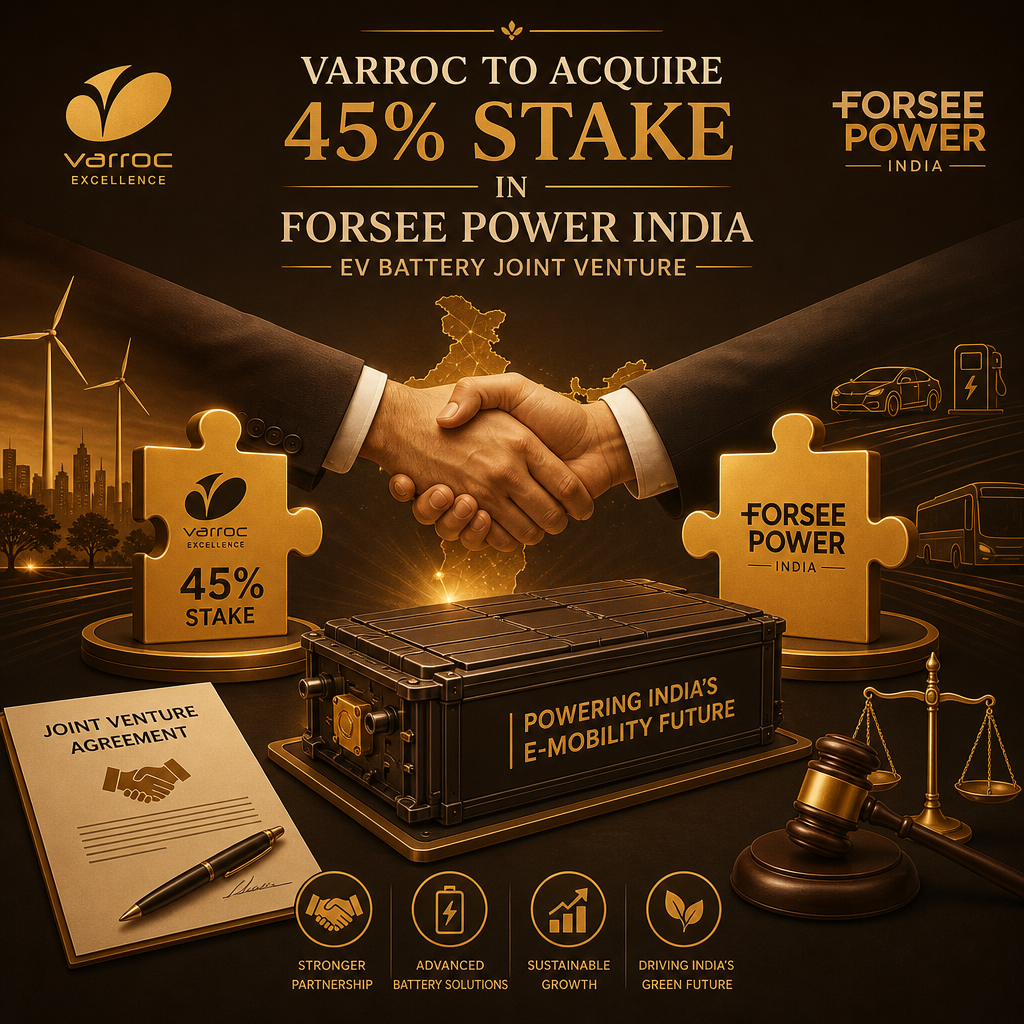
Varroc Engineering Limited has agreed to acquire a 45% stake in Forsee Power India Private Limited as part of a strategic joint venture with France-based Forsee Power SA. The partnership is intended to strengthen and expand the manufacturing of lithium-ion battery systems for electric vehicles in India.
Shardul Amarchand Mangaldas & Co. (SAM) advised Varroc, an Indian listed automotive component manufacturer, on the transaction. The investment combines a purchase of existing equity shares from Forsee with fresh subscriptions to equity shares and optionally convertible redeemable preference shares, or OCRPS, in the Indian company.
The commercial arrangement also includes an exclusive, royalty-bearing technology licence from Forsee to the company for manufacturing and supplying battery systems in India and the SAARC region. The transaction therefore brings together an ownership investment, funding for the operating company and access to battery technology.
The disclosed terms describe an agreement to acquire the stake, rather than a completed acquisition. The transaction account does not specify the consideration, valuation, completion timetable or detailed governance arrangements between the joint venture partners.
Key Highlights
45% acquisition: Varroc has agreed to acquire a substantial stake in Forsee Power India through a combination of secondary and primary investment.
Mixed investment structure: The transaction involves existing equity shares, newly issued equity shares and optionally convertible redeemable preference shares.
Technology access: Forsee has agreed to provide an exclusive, royalty-bearing licence covering manufacturing and supply in India and the SAARC region.
EV manufacturing focus: The company manufactures, assembles, tests and validates battery systems for two-wheelers, three-wheelers, other light electric vehicles and buses.
Legal advisory: SAM deployed transaction and intellectual property teams, with the transaction team led by partners Rudra Kumar Pandey and Amanjot Malhi.
Varroc agrees to acquire 45% stake in Forsee Power India
The proposed acquisition places Varroc alongside Forsee in an Indian operating company focused on electric-vehicle battery systems. For Varroc, the arrangement connects its automotive component manufacturing business with Forsee’s battery technology through an investment in Forsee Power India, rather than merely a supply relationship.
The transaction account describes the ownership commitment in these terms:
“Varroc has agreed to acquire a 45% stake in Forsee Power India Private Limited”
A 45% interest is a significant shareholding, but the percentage alone does not establish how the company will be controlled. Board composition, voting arrangements, reserved matters and contractual consent rights can all shape decision-making in a joint venture. None of those terms has been disclosed in the supplied account.
The distinction between signing and completion is also material. An agreement to acquire shares records a contractual commitment, while completion ordinarily involves implementing the agreed transfers and allotments. The available information does not establish whether any closing conditions remain outstanding, what those conditions might be, or when the acquisition will take effect.
Deal structure combines secondary share purchase and fresh investment
The transaction uses two distinct investment routes. Varroc will purchase existing equity shares from Forsee through a secondary transaction and subscribe to newly issued securities in Forsee Power India through a primary investment. The fresh subscription covers both equity shares and OCRPS.
These routes serve different purposes. In a secondary purchase, consideration ordinarily goes to the selling shareholder in exchange for its existing shares. A primary subscription, by contrast, brings subscription proceeds into the company issuing the securities. The disclosed structure therefore combines a change in ownership with an investment into the operating entity.
OCRPS introduce a further layer to the capital structure. Their description identifies preference shares that are optionally convertible and redeemable, but the commercial consequences depend on their actual terms. Conversion rights, redemption mechanics, dividend entitlements and the identity of the party holding a conversion option cannot be inferred from the instrument’s name alone.
The account does not disclose the allocation of consideration between the secondary purchase and fresh subscription, or explain how the OCRPS are treated in calculating the stated 45% stake. Legally, share transfers and fresh issuances involve different corporate steps. The applicable company-law and foreign-exchange framework would need to be considered against the parties’ residency, the securities involved and the final transaction terms.
Joint venture targets expansion of lithium-ion EV battery manufacturing
The stated objective is to strengthen and scale up the manufacturing of lithium-ion battery systems in India. The scope expressly includes battery management systems, placing the venture’s focus on battery-system capability rather than describing an investment limited to an individual component.
The transaction account sets out that objective as follows:
“The joint venture aims to strengthen and scale up the manufacturing of lithium-ion battery systems, including battery management systems, for electric vehicles in India.”
Battery management systems generally monitor and manage battery operation, making their inclusion relevant to the functionality of the overall product. The source does not, however, identify a particular system architecture, technical specification or proprietary feature that will be introduced through the partnership.
The expansion objective must also be distinguished from a quantified capacity commitment. No investment amount, production target, plant location or commissioning schedule has been disclosed. Nor does the account state that the venture will manufacture lithium-ion cells themselves. Manufacturing battery systems can involve a different industrial scope from cell production, and the disclosed description should not be read as establishing both.
For execution, the relationship between investment and technology access will be important: financing supports the company’s activities, while the licence supplies the contractual basis for using Forsee’s technology within the agreed scope.
Forsee grants exclusive technology licence for India and SAARC
Alongside the investment arrangements, Forsee has agreed to grant Forsee Power India an exclusive technology licence for manufacturing and supplying its battery systems. The stated territory encompasses India and the SAARC region, giving the licensing arrangement a regional dimension beyond the Indian manufacturing objective.
The account describes the proposed grant as:
“an exclusive, royalty-bearing technology license for the manufacturing and supply of its battery systems in India and the SAARC region”
The words “exclusive” and “royalty-bearing” identify two important commercial features. Exclusivity concerns the licensee’s rights within the contractually defined scope, while royalties create a payment obligation associated with the licensed technology. Neither expression, by itself, reveals the full extent of the rights or the payment formula.
The licence’s duration, royalty rate, payment basis, sublicensing rights and termination provisions have not been disclosed. It is also unclear how the agreement addresses future technology improvements, technical assistance or use of the technology after termination. These are ordinarily significant drafting questions where an operating company depends on technology supplied by a shareholder.
A licence is distinct from an assignment of intellectual property ownership. The disclosed arrangement establishes agreed access to technology, not a stated transfer of ownership. Equally, its territorial coverage should not be treated as evidence of existing sales operations or regulatory permissions throughout the region.
Partnership pairs Forsee battery technology with Varroc's manufacturing reach
The commercial rationale is the combination of Forsee’s battery technology with Varroc’s manufacturing, customer and management capabilities. The source presents those capabilities as complementary contributions intended to support localisation and the expansion of EV battery solutions in India.
That allocation of strengths explains why the transaction extends beyond a share purchase. Technology access can support the products the company is authorised to manufacture, while manufacturing and management capabilities can assist operational execution. Customer relationships may also be relevant to commercial development, although no customer contracts or order commitments are identified.
In legal terms, an equity investment and a technology licence govern different aspects of the relationship. Shareholding arrangements address economic participation and corporate rights; licensing provisions determine permitted technology use. Their interaction can become important if ownership changes, a shareholder exits or the licence ends.
The disclosed account does not say how the parties have addressed those contingencies. It would therefore be premature to infer exit rights, continuing supply obligations or guaranteed technology access following a change in ownership. Likewise, localisation is the stated direction of the partnership, not a disclosed commitment to a particular domestic-content percentage, sourcing programme or production milestone.
Company supplies battery systems for two-wheelers, buses and other EVs
Forsee Power India’s activities span manufacturing, assembly, testing and validation of battery systems. Its stated product coverage includes electric two-wheelers, three-wheelers, other light electric vehicles and buses. The business is therefore described across several vehicle categories, rather than as dedicated to a single EV segment.
Those categories can involve different operating requirements. Vehicle size, duty cycles and charging patterns may affect battery-system design and validation. The source does not identify individual products, battery capacities, customer names or the relative contribution of each vehicle segment to the company’s business.
The inclusion of testing and validation is significant because it describes capabilities beyond assembly. In general, these processes help assess whether a system meets defined performance and operating requirements. They should not, however, be equated with a claim that any particular statutory certification or customer approval has been obtained.
Battery-system manufacturing also raises product-quality, safety and contractual risk-allocation questions. Applicable requirements depend on the product, vehicle category and destination market. Nothing in the transaction account establishes a compliance finding, an approval deficiency or a particular regulatory clearance. The disclosed facts support a description of the company’s operating scope, but not conclusions about undisclosed certifications or future market access.
Shardul Amarchand Mangaldas transaction and intellectual property teams
SAM advised Varroc on the strategic joint venture. Its transaction team was led by Rudra Kumar Pandey, Partner, and Amanjot Malhi, Partner. The involvement of a separate intellectual property team reflects the transaction’s combination of investment arrangements and technology licensing, although the account does not allocate individual drafting responsibilities.
The transaction team also comprised Jyoti Gautam, Principal Associate; Deepti Pandey, Senior Associate; Rachit Grover, Senior Associate; and Adrija Ghosh, Associate.
The intellectual property team comprised Dev Robinson, Partner; Aishwarya Chaturvedi, Senior Associate; and Shivali Prasad, Associate. No legal adviser to Forsee or separate adviser to Forsee Power India is identified in the supplied material.
The next publicly relevant development would be confirmation of implementation of the agreed acquisition and investment, together with any further disclosed particulars of the partnership. For now, the announced position remains an agreement for a 45% acquisition supported by fresh investment and an exclusive technology-licensing arrangement; no completion date or operative closing steps have been specified.
Legal representation: Shardul Amarchand Mangaldas & Co. advised Varroc Engineering Limited through the transaction and intellectual property teams identified above.
Sources