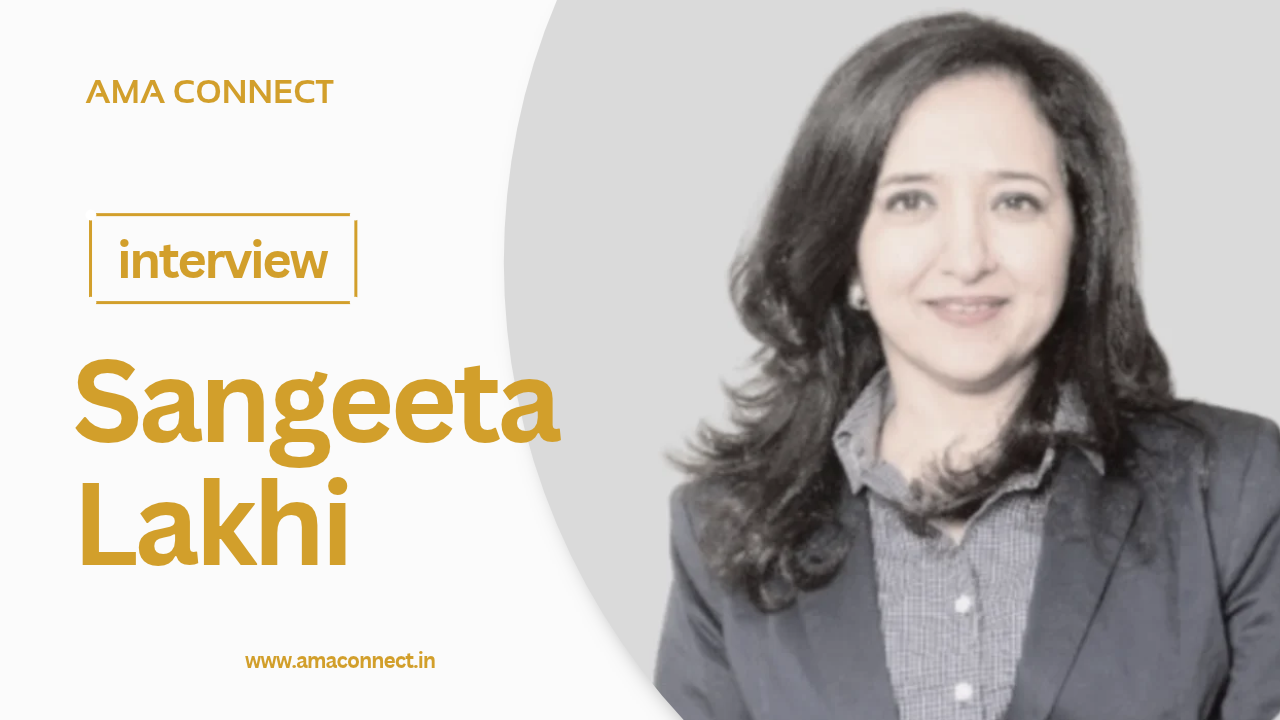
In Conversation with Sangeeta Lakhi
Senior Partner at Rajani Associates, Advocates & Solicitors, Mumbai
1. What drew you towards banking & finance, structured finance, and capital markets, and what has kept you passionate about them?
Sangeeta Lakhi:
I did not begin with a plan. I qualified in law in 1993 and joined Crawford Bayley & Co., where early exposure to corporate and commercial work taught me far more than any syllabus could have. When I moved to Rajani Associates, I did what most young lawyers do: I accepted every assignment that came my way, often before I was entirely certain I could execute it.
Over time, I found that financial transactions suited the way my mind works. They are structured, each has a defined commercial purpose, and each turns on the same question: how does one move money from a party that has it to a party that needs it, in a manner that is legally sound, tax-efficient, acceptable to the regulator and fair to both sides? That question has never stopped interesting me.
2004 was a turning point. International markets opened up to Indian issuers, and I took charge of the firm's International Capital Markets practice. I have since closed well over a hundred GDR, FCCB and QIP issuances, and no two have been alike. The instrument may carry the same name on paper, but the issuer, the sector, the currency, the jurisdiction of listing and investor appetite change the transaction entirely.
When international markets went quiet after 2008, I returned to domestic banking, lending and corporate work. that period proved formative in its own right. It gave me command of both sides of the balance sheet, and a capital markets lawyer who also understands lending documentation, security creation and enforcement is better placed to serve a client. What has kept me engaged for over three decades is the visibility of this work. A company raises capital, builds a plant, creates employment, and one can trace a direct line from the document drafted to the outcome achieved.
2. You have advised on IPOs, QIPs, GDRs, and FCCBs. Which type of transaction do you find the most challenging, and what makes it legally demanding?
Sangeeta Lakhi:
FCCBs, a Foreign Currency Convertible Bond appears simple on paper: foreign currency debt that converts into equity. It is demanding to execute well because it is two instruments at once. Until conversion, it is debt; thereafter, it is equity. The transaction must, therefore, satisfy two different regulatory frameworks at the same time.
On any FCCB, one is working within the external commercial borrowing framework, RBI's pricing and end-use restrictions, FEMA, the Companies Act, SEBI's issue and listing regime, the FCCB Scheme itself, the rules of the overseas exchange on which the bonds are listed, and the law governing the trust deed, which is very often English law. Indian counsel, foreign counsel, the trustee, the lead manager, the depositary and the auditors must be coordinated, typically across three or four time zones and within a compressed pricing window.
The harder issue, and one rarely negotiated with enough rigour at the outset, is what happens when the share price falls. The conversion price is fixed at issuance. Where the underlying stock underperforms, bonds that all parties assumed would convert quietly into equity become a hard redemption liability, payable in foreign currency on a fixed date, often with a redemption premium and an unfavourable exchange rate. I have seen financially sound companies pushed into distress on precisely this account. Reset clauses, redemption mechanics, events of default and restructuring flexibility built in at the drafting stage are therefore, never boilerplate; they are the substance of the transaction. Drafting an FCCB competently means drafting for the scenario in which optimism proves misplaced.
3. Rajani Associates recently advised Genesys International Corporation Limited on its ₹125 crore rights issue. Could you take us behind the transaction and share some of the key legal challenges?
Sangeeta Lakhi:
Genesys International Corporation Limited raised ₹125.37 crore through a rights issue of 2,50,74,226 equity shares of ₹5 face value each, priced at ₹50 per share, in a ratio of three rights shares for every five held, with 6 August 2026 as the record date. The issue opened on 14 August and closed on 21 August 2026, with listing on both the BSE and the NSE. Our mandate covered legal due diligence, preparation and finalisation of the offer documents, negotiation and finalisation of the rights issue agreements, and assistance to the company through the entire process. I led the transaction, with Shriya Nandedkar and Sudhanshu Kulkarni.
The first challenge was the regime itself. Following SEBI's 2025 reforms, the draft letter of offer is now filed with the stock exchanges rather than SEBI, the appointment of a merchant banker is no longer mandatory for qualifying issues, and the process is expected to conclude within a tightly defined timeline from board approval. The gain in speed and cost for issuers is real. But the due diligence certificate historically furnished by a merchant banker no longer exists, and responsibility for the accuracy and adequacy of disclosure now rests squarely with the company, its board and its counsel. A compressed timeline does not reduce the diligence required; it reduces the time available to complete it. This shaped how we structured the transaction: diligence and drafting proceeded in parallel from the outset, rather than in sequence.
The second challenge was particular to the issuer. Genesys operates in geospatial technology, mapping, and survey services, a business whose value lies in intellectual property, data assets, sectoral licenses, and long-cycle contracts rather than tangible plant. Diligence on such a company is a different exercise. It requires examining data and licensing arrangements, sector-specific regulatory permissions, contractual restrictions, and the strength of the company's rights over what it actually sells. Translating that into disclosure that is complete and accurate, without being commercially prejudicial, calls for judgement.
The third was procedural. In-principle approvals from both exchanges, the record date, credit of rights entitlements to demat accounts, the on-market renunciation window, fractional entitlement rules, the promoter group's subscription and renunciation position, and the ASBA process all had to be sequenced with precision, because the dates in a rights issue are published to the market and cannot move without consequence. Continuing disclosure obligations under the LODR Regulations, while the issue was live, and coordination with the registrar, the exchanges, and the depositories compounded this.
What brought the transaction home on schedule was preparation rather than legal ingenuity: a management team that responded promptly to diligence queries and an advisory team experienced enough to anticipate where such processes typically falter.
4. What is one recent or emerging SEBI development that could significantly impact companies and investors?
Sangeeta Lakhi:
If I had to identify a single development, it would be the overhaul of the rights issue framework, because it reflects SEBI's wider shift toward what the Chairman has described as ‘optimum regulation’: easing the process of capital raising while reallocating responsibility to issuers, boards, and intermediaries.
On their face, the changes are procedural. The draft letter of offer is filed with the exchanges rather than SEBI, the merchant banker is optional, promoters may renounce entitlements in favour of named investors, and the entire process has been compressed into a matter of weeks. Together, they have revived the rights issue as a serious fundraising route. Companies that would previously have defaulted to a QIP or a preferential allotment are now reconsidering it in earnest. This is a significant commercial development, not merely a procedural one.
The 2026 amendments to the ICDR Regulations reflect the same philosophy. A standardised draft abridged prospectus, together with a QR code on every application form giving access to the offer documents, is intended to make disclosure usable for the retail investor rather than merely compliant on paper. Permitting depositories to mark pledged pre-issue non-promoter shares as non-transferable to satisfy lock-in requirements removes an operational irritant without diluting the underlying protection. For foreign investors, the parallel reforms on net settlement of funds for foreign portfolio investors in the cash market and the move toward single-window access for low-risk foreign investors, address the cost and friction of participation rather than only the rules of entry.
The caution I would offer is that a lighter process is not a lighter liability. When the regulator withdraws from pre-vetting, the consequences of deficient disclosure do not disappear. They surface later, and typically through enforcement rather than a comment letter. We have already seen substantial fundraising efforts disrupted because draft offer documents were returned for deficiencies. Boards must appreciate that the diligence burden has shifted decisively onto them.
5. How do you balance legal compliance, commercial objectives, and tight deadlines while protecting the client's interest?
Sangeeta Lakhi:
I begin by declining to treat compliance, commercial objectives and deadlines as equally negotiable, because they are not. Compliance defines the boundary of the field. Within that boundary, there is very often more commercial latitude than clients expect, and it is the lawyer's task to find it rather than default to refusal at the first sign of difficulty. A lawyer who cannot distinguish between what is prohibited and what is merely unfamiliar is of limited use in a live transaction.
A few disciplines help. The first is to front-load diligence. In any time-bound issuance, the problems capable of threatening the timetable can almost always be identified within the first week: a title defect, an approval not yet obtained, a restrictive clause in an existing facility agreement or unresolved litigation. Diligence exists to surface such matters early, not to produce a comprehensive report at the end of the exercise. An issue identified on day three is a manageable task; the same issue identified on day twenty-five becomes a crisis.
The second is candour with the client about the difference between risk that can be managed and risk that cannot. A good deal of commercial pressure in any transaction comes from uncertainty over whether something is fatal or merely inconvenient. Where one can answer that question with precision (this is the exposure, this is its likelihood, this is the available mitigation, and this is my recommendation), clients can decide soundly and quickly. Advice that is heavily qualified and leaves the decision entirely to the client is an abdication of the lawyer's function, not prudence.
There is a short list of matters I will not compromise for any deadline: the accuracy of disclosure, the integrity of the approval chain and anything that would expose the board to personal liability. Everything else is a matter of sequencing and negotiation. In thirty-three years, I cannot recall a transaction I have regretted on account of an additional week taken to complete it.
Sangeeta Lakhi:
The core skill will remain unchanged. Someone must still determine who owes what to whom, on what terms, secured against what, and what follows should matters go awry. No technology has displaced that inquiry. What has changed is the environment in which the question is posed.
I would identify three shifts. First, the underlying asset is becoming harder to secure. Traditional security law was designed around assets one could identify, register and, if necessary, repossess: land, plant, receivables, shares. An increasing proportion of lending is now extended against data, digital platforms, subscription revenue streams and other intangible rights. Creating enforceable security over such assets, and realising real value upon enforcement, remains an unresolved question in most jurisdictions, including our own. Lawyers who can engage seriously with that problem will be in demand.
Second, the counterparty structure is fragmenting. A single credit product may now involve a bank, a non-banking financial company, a technology service provider, a platform, and a co-lending or sourcing arrangement connecting them. Allocating responsibility for customer data, consent, fair practices, grievance redressal and regulatory breach across that chain has become a substantial part of the drafting exercise itself. The RBI's digital lending framework is a firm reminder that outsourcing the activity does not outsource the accountability.
Third, compliance is becoming continuous rather than periodic. Reporting is increasingly conducted in real time and interpreted by machines rather than reviewed at intervals by individuals. The lawyer's function shifts from periodic document review to designing systems that remain compliant by construction.
For a young lawyer, the practical implication is that domain fluency is no longer optional. Coding is not required, but a working understanding of the product is: where the data resides, how funds move, and who interacts with the customer. That understanding is what allows one to ask informed questions. Those who can hold that conversation with a product team will do well. Those who wait to be handed a completed term sheet will find that the substantive work has already been shaped without their input.
7. For law students aspiring to enter Banking & Finance or Capital Markets, what is one skill or mindset that can truly set them apart?
Sangeeta Lakhi:
Most young lawyers are trained to analyse the document before them, and they generally do so with competence. Very few pause to ask what the company is actually seeking to achieve, where the proceeds are destined, what concerns the promoter, and what the investor requires to be persuaded. Once that understanding is in place, one's drafting changes. One learns to distinguish the clause that matters from the clause contested purely out of habit, and to advise the client on which risk merits negotiation. One stops producing advice that is technically correct yet commercially unhelpful.
In practice, this means reading the balance sheet and not only the articles of association. It means following the sector in which one's client operates, understanding why the pricing was set at a particular level, and asking the senior on the file why a structure was adopted, rather than only how it is to be implemented.
The companion discipline is patience with detail. This practice does not forgive carelessness: an incorrect date, a misdescribed security or an omitted disclosure can cost a client dearly. Excellence in this field is, in large measure, the cumulative product of small tasks executed correctly and repeatedly, particularly when no one is checking the work.
Finally, the law one learns in college will be substantially amended within a decade, but the discipline of continuous learning will not go out of date. Every regulation I work with today has been revised at least once since I qualified. Cultivate that discipline; the substance of the law will, in any event, keep changing.