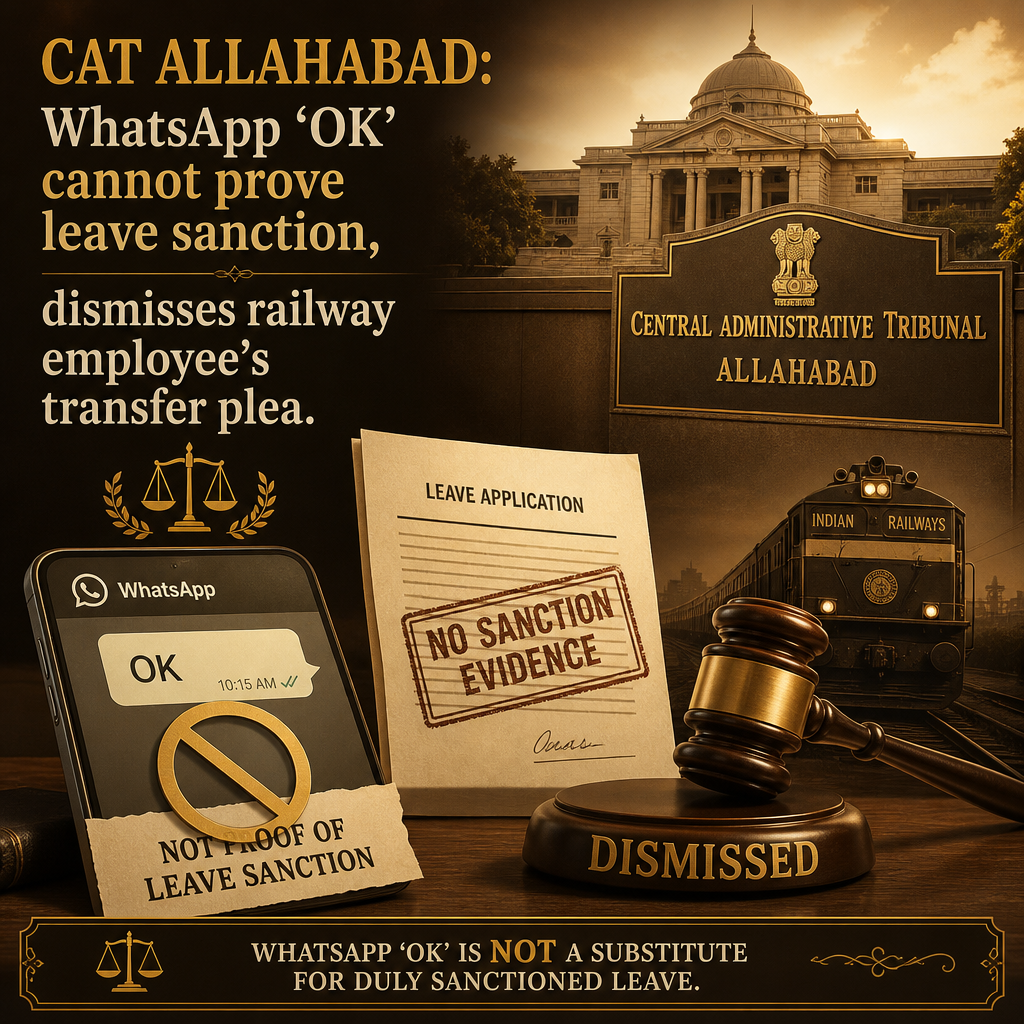
The Central Administrative Tribunal (CAT), Allahabad, has dismissed a railway employee’s challenge to his transfer from Prayagraj to Fatehpur, holding that a senior officer’s WhatsApp reply saying “OK” could not, by itself, conclusively establish that leave had been sanctioned by the competent authority.
Judicial Member Rajnish Kumar Rai, in an order dated October 7, rejected the employee’s contention that the transfer and consequential relieving order were punitive. The Tribunal found that the Railways had demonstrated an independent administrative reason for deploying him at Fatehpur.
The dispute arose after the employee, who had taken three days of leave to visit his native village, sought two additional days through WhatsApp. He relied on an alleged response from a senior officer to argue that the extension had been approved, while the Railways maintained that leave required sanction through the prescribed portal.
The decision turned on two connected but distinct questions: whether the message established authorised leave, and whether the transfer was punishment in disguise. The Tribunal found neither conclusive proof of leave sanction in the WhatsApp response alone nor sufficient material to displace the administrative explanation for the transfer.
Key Highlights
WhatsApp reply not conclusive: The Tribunal held that an alleged “OK” response could not, by itself, prove sanction of leave by the competent authority.
Punitive transfer alleged: The employee challenged his transfer from Prayagraj to Fatehpur and the consequential relieving order, alleging that they were arbitrary and linked to his absence.
Portal-based sanction: The Railways argued that leave had to be approved through the appropriate portal and that submitting a request did not amount to obtaining permission.
Independent staffing requirement: A new entry and booking office at Fatehpur Railway Station, a requirement for staff and an available vacant post supported the transfer.
No interference: The Tribunal found no specific and cogent material establishing mala fides or punishment in disguise and dismissed the plea.
CAT Allahabad dismisses challenge to railway employee's transfer
The employee approached the Tribunal against two linked administrative actions: the order transferring him from Prayagraj to Fatehpur and the consequential order relieving him. His challenge sought to question not merely the change of posting, but the purpose for which the transfer power had allegedly been exercised.
According to his case, the orders were not routine measures taken in the public interest. He alleged that the transfer was punitive and connected to his absence from duty, making the circumstances surrounding his leave request central to the dispute.
The Railways presented a different explanation. It maintained that the posting was required to meet staffing needs at Fatehpur and had followed the placement committee process, with approval from the competent authority.
The Tribunal accepted that an identifiable administrative basis existed. Its dismissal therefore rested on more than a rejection of the employee’s interpretation of a WhatsApp message: the order also examined whether the destination station had a genuine staffing requirement and whether the transfer had passed through the administrative process.
The employee’s account began with a visit to his native village after availing three days of leave. He subsequently sought an extension of two days, communicating the request through WhatsApp rather than relying on a further sanction established through the prescribed portal.
He said the request was approved by the Senior Divisional Commercial Manager/Coaching, Prayagraj, who replied “OK”. On his version, that response signified acceptance of the additional leave and was relevant to assessing the later action taken against him.
The distinction mattered because the employee alleged a connection between his absence and the transfer. His counsel argued that the transfer and relieving orders were punitive and arbitrary, rather than ordinary administrative measures undertaken in the public interest.
That argument required the Tribunal to consider both the meaning attributed to the communication and the character of the transfer. Even if an employee understands a message as permission, the separate question remains whether it establishes sanction by the authority empowered to grant leave. Likewise, a dispute about absence does not, without more, establish that a subsequent posting order was issued as punishment.
Railways argues leave required approval through the prescribed portal
Opposing the application, the Railways submitted that leave had to be sanctioned through the appropriate portal by the competent authority. Its position drew a clear distinction between making a leave application and securing approval of that application.
This distinction was central to its response to the WhatsApp claim. The Railways did not accept that the employee’s reliance on the alleged message established completion of the prescribed sanction process. Mere submission of a request, it argued, did not itself authorise the leave sought.
In administrative terms, a leave request and a leave sanction perform different functions. The former communicates an employee’s wish to remain away from duty; the latter records the employer’s permission through the applicable decision-making mechanism. The controversy here concerned whether the brief response relied upon by the employee was sufficient proof of the latter.
The Railways also defended the transfer on grounds independent of the leave dispute. It cited an urgent requirement for staff at Fatehpur, the development of a new entry and booking office, and a vacant post against which the employee could be transferred. It further relied on a placement committee recommendation and approval by the competent authority.
Tribunal says an 'OK' reply alone does not prove leave was sanctioned
Addressing the employee’s principal reliance on the message, the Tribunal held that the alleged reply was insufficient, standing alone, to conclusively establish leave sanction. The observation was directed at the evidentiary weight of the communication in the circumstances before it.
“…the alleged WhatsApp response ‘OK’ relied upon by the applicant cannot, by itself, be treated as conclusive proof of sanction of leave by the competent authority…”
The qualifications in that observation are important. The Tribunal referred to the “alleged” response and said that it could not “by itself” constitute conclusive proof. The finding should therefore not be read as a categorical declaration that WhatsApp communications can never be relevant to an employment dispute.
Rather, the order distinguishes an informal acknowledgement from proof of a formal administrative decision. The issue was not simply whether the expression “OK” conveyed assent in ordinary conversation, but whether it demonstrated sanction of leave by the competent authority in the applicable process.
That narrower reading also preserves the distinction between communication and authorisation. A short electronic response may form part of the factual record, but the Tribunal was not persuaded that this response alone resolved the question of sanctioned leave. The employee’s interpretation consequently did not provide a sufficient basis to undermine the transfer orders.
New booking office and vacant post provide an administrative basis for transfer
The Tribunal found that the Railways had disclosed an identifiable and independent reason for the transfer: the development of a new entry and booking office at Fatehpur Railway Station. The resulting staff requirement supplied a concrete operational explanation for the posting.
The availability of a vacant post was another relevant feature. The Railways’ case was that the employee had been moved against that vacancy, rather than transferred without reference to an available position or an identified staffing need.
The administrative sequence also mattered. The Railways stated that the placement committee had recommended the transfer and that the competent authority had approved it. The Tribunal noted that the transfer had proceeded through the administrative process and received the requisite approval.
Taken together, these circumstances gave the Tribunal a basis to assess the transfer separately from the disagreement over leave. The new facility explained why staff were required at Fatehpur; the vacancy identified where the employee could be accommodated; and the recommendation and approval explained how the decision had been processed. This combination supported the Railways’ contention that the transfer served an operational purpose.
No cogent material establishes mala fides or punishment in disguise
The employee’s allegation of a punitive transfer required more than showing that a leave-related disagreement existed. The Tribunal examined whether there was specific material supporting the claim that the stated administrative reason concealed an improper purpose.
Referring to the operational justification, the Tribunal observed:
“Looking to the aforesaid administrative exigency and the requirement of ensuring proper functioning of the concerned work…”
It then explained why the employee’s allegation did not warrant interference:
“…the action of the respondents cannot, in the absence of specific and cogent material, be said to have been actuated by mala fide or to constitute punishment in disguise”
The reasoning distinguishes an allegation about motive from material capable of substantiating it. Here, the Tribunal found an independently explained need for staff and an approved administrative process, without sufficient material establishing that these reasons were a cover for punishment. The finding was specific to the record before it: the existence of a leave dispute did not, on its own, displace the explanation for the posting or establish that the transfer power had been misused.
Transfer and relieving orders remain undisturbed
Having rejected the employee’s grounds for intervention, the Tribunal found no sufficient reason to interfere with either the transfer order or the consequential relieving order. The plea was accordingly dismissed, leaving both administrative actions undisturbed.
The outcome reflects the two strands of the Tribunal’s reasoning. First, the alleged WhatsApp response did not conclusively prove sanction of the additional leave. Second, the Railways had supplied an independent administrative basis for moving the employee to Fatehpur.
These findings should not be conflated with a wider ruling on every form of electronic workplace communication. The order addresses the sufficiency of this alleged response as proof of leave sanction and the adequacy of the grounds advanced against this transfer. It does not make the messaging platform itself the determining issue.
For the transfer challenge, the decisive circumstances were the new entry and booking office, the requirement for staff, the vacant post and the administrative approval process. In the absence of specific and cogent material showing mala fides or punishment in disguise, the Tribunal declined to set aside the decision. The transfer from Prayagraj to Fatehpur and the consequential relieving order therefore remain in force.