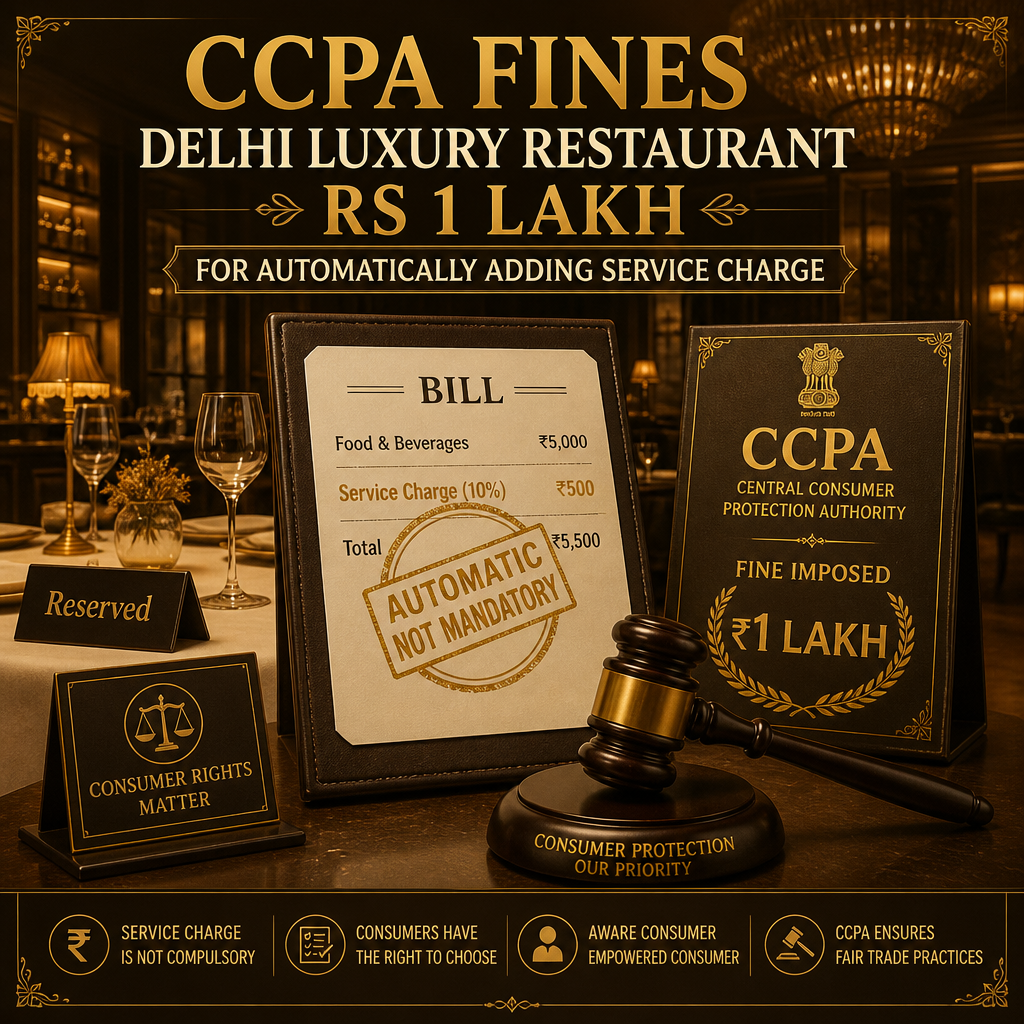
The Central Consumer Protection Authority (CCPA) has imposed a ₹1 lakh fine on a luxury restaurant in Delhi for automatically adding a service charge to food bills and requiring customers to seek its removal. The authority held the restaurant liable for unfair trade practices, misleading advertisements, and violation of consumer rights.
Chief Commissioner Nidhi Khare and Commissioner Anupam Mishra considered two complaints concerning a 10 per cent service charge levied at the restaurant’s outlet. In its October 22 order, the authority rejected the defense that the charge was discretionary because customers could ask for a waiver.
The central issue was whether describing a charge as optional could justify including it in every bill through the restaurant’s billing software. The CCPA found that this arrangement created an opt-out mechanism, rather than requiring customers to make a voluntary choice to pay.
The authority directed the restaurant to discontinue automatically levying service charges, including under any other name. Its reasoning focused on upfront price disclosure, informed consumer consent, and the distinction between voluntarily rewarding service and having to challenge an amount already included in a bill.
Key Highlights
₹1 lakh penalty: The CCPA found the restaurant liable for unfair trade practice, misleading advertisement, and violation of consumer rights.
Two disputed bills: The proceedings arose from complaints concerning a 10 per cent service charge on bills dated May 30, 2025, and June 10, 2025.
Optional-charge defense rejected: The restaurant said the charge was disclosed on its menu and removable on request. The authority found that this did not establish voluntary payment.
Software default under scrutiny: Renaming the charge did not address its automatic inclusion or the burden placed on customers to secure its removal.
Directions against default billing: The restaurant was ordered to stop automatically adding service charges, whether under that description or another name.
CCPA imposes Rs 1 lakh fine on a Delhi restaurant over a default service charge.
The CCPA’s order addresses the practice of presenting a service charge as part of the amount payable while maintaining that the customer remains free to refuse it. The authority held that the ability to request deletion did not cure the problem created by including the charge automatically.
The ₹1 lakh fine followed findings of unfair trade practice, misleading advertisement, and interference with consumer rights. Alongside the monetary penalty, the authority issued a direction aimed at changing the restaurant’s billing practice, rather than merely its description of the charge.
As a consumer protection regulator, the CCPA’s scrutiny concerned more than the resolution of an individual billing disagreement. The proceedings examined whether a standardized practice could affect consumers generally, particularly when the disputed addition was generated through software rather than entered as an isolated transaction.
The distinction between a voluntary payment and a default addition was therefore central to the outcome. A customer’s willingness to pay for food at a displayed price could not, on the authority’s reasoning, be treated as consent to a separate service charge. Nor could the availability of a waiver substitute for a freely exercised choice at the outset.
Two customer complaints trigger inquiry into 10 percent charge on food bills.
The matter began with two consumer allegations that the restaurant’s outlet had forcibly levied a 10 percent service charge. The disputed food bills were dated May 30, 2025, and June 10, 2025, placing two separate transactions before the authority.
The CCPA first directed an initial inquiry to verify the allegations. That inquiry found that a service charge had indeed been levied on the bill, giving the authority a factual basis to examine the restaurant’s billing method beyond the complaints themselves.
The software-generated nature of the bill assumed particular significance. The authority considered that a default built into the billing system might have affected many more consumers and regarded the matter as fit for class action. This was a concern about the potential reach of the practice, not a finding identifying a particular number of additional affected diners.
The CCPA subsequently issued a notice to the restaurant on July 28, 2025, seeking its response. The sequence moved from verification of the individual allegations to consideration of a potentially wider consumer issue while giving the restaurant an opportunity to explain its disclosures, billing process and position on voluntary payment.
The restaurant says the service charge was optional and removable on request
In response, the restaurant maintained that its menu specifically disclosed the service charge and described it as discretionary. It said customers could have the amount removed on request and denied either forcing payment or misleading diners about the charge.
The restaurant also contended that the customer had sufficient opportunity to decline payment but had not done so before or after settling the bills. Its defense, therefore, relied on disclosure and the availability of refusal: customers were told about the charge and, according to the restaurant, could choose not to pay it.
Advocate Vidhi Goel, appearing for the restaurant, further submitted that staff verbally asked consumers whether they were comfortable paying the service charge before it was levied. This submission sought to establish that the payment was not imposed without an opportunity for the diner to express a preference.
Counsel also stated that the bills had been updated to describe the amount as “Voluntary Service Staff Contribution (Optional)." The restaurant assured compliance with the relevant guidelines and complete removal of the service charge across its branches. These submissions addressed both the language used on the bill and the restaurant’s proposed compliance, but the authority separately examined whether the billing system continued to add the amount by default.
Investigation finds automatic billing can pressure customers into paying
Following the restaurant’s response, the CCPA directed a detailed investigation. The resulting report identified the automatic inclusion of the service charge as the principal concern, rather than treating the dispute as one confined to the wording of the menu.
The report found that automatic billing could lead diners to understand the charge as compulsory. It described the practice as one that:
“exerts undue pressure on the customer”
The investigation treated this as an unfair trade practice and a violation of consumer rights, emphasising consumers’ entitlement to protection and their right to be informed. The concern was that an amount presented within the bill could carry the appearance of an ordinary payment obligation, even where the restaurant said it could be removed.
This reasoning distinguishes notice from meaningful choice. A diner may be aware that a charge exists without having affirmatively agreed to pay it. Once it appears in the total, the consumer must take an additional step to dispute or remove it. The report’s findings placed that burden at the centre of the inquiry: an ostensibly optional charge could still influence payment through the way it was presented and collected.
The CCPA linked its findings to the function of a menu as an upfront statement of price. Restaurants, it observed, have freedom to set the prices of their food and beverages, and the service component is already inherent in that pricing.
Explaining the scope of a customer’s consent when placing an order, the authority stated:
“When a restaurant displays prices on its menu, a component of service is already inherent in the pricing of the food and beverages offered, ensuring consumers are informed of the actual cost upfront. Because restaurants have absolute freedom to set their menu prices, placing an order constitutes consent only to pay the displayed price plus applicable taxes.”
The reasoning separates the restaurant’s freedom to determine its prices from its ability to add another amount at the billing stage. The order does not proceed on the basis that service has no cost. Rather, it treats that cost as a matter to be reflected in the prices displayed to consumers when they decide what to order.
The authority further found that adding a service charge created an express or implied representation concealing the true cost of food and service, thereby misrepresenting the final cost of dining out. Its misleading-advertisement finding thus rested on the relationship between the price communicated to the consumer and the amount subsequently presented for payment, alongside the unfair-trade-practice finding concerning default collection.
The restaurant’s revised terminology did not resolve the authority’s concern. Although the bill described the payment as voluntary and optional, the CCPA noted that the service charge remained embedded in the billing software by default.
The authority characterized the arrangement as:
“an opt-out mechanism rather than an opt-in requirement”
That distinction explains why the billing system mattered independently of the label. Under an opt-out arrangement, the charge is included unless the consumer acts to remove it. An opt-in requirement, by contrast, places the decision to make a voluntary payment with the consumer before the amount is added. The CCPA found that the restaurant’s approach created an impression of compulsory payment and shifted the burden of correction to diners.
The authority also held that mentioning on the menu that the charge was optional undermined free and informed consumer consent in the circumstances of this billing practice. Read with its findings on software-generated bills, the objection was not simply to inadequate wording. It was to a process in which the restaurant first included the payment and then expected the customer to object, despite maintaining that the payment was discretionary.
Restaurant directed to stop levying service charges by default
The CCPA ultimately held the restaurant liable for misleading advertisement and unfair trade practices and ordered it to pay a ₹1 lakh fine. It also directed the restaurant to discontinue automatically levying any service charge, whether by default or under another name.
The authority expressly located the choice to make such a payment with the diner. Its order stated that a service charge:
“ought not to be added by default in the bill/invoice and should be left to the customer’s discretion as service charge or TIP is a voluntary payment by the consumer.”
The reference to other names gives the direction significance beyond the particular description used in the disputed bills. Changing the charge to a voluntary staff contribution would not, by itself, address the finding if the same amount continued to appear automatically. The operative requirement concerns how the payment is sought and included, not merely the heading beneath which it appears.
The restaurant’s assurance of removal across its branches was a submission made during the proceedings. The final direction requires discontinuation of the default practice, reinforcing the distinction between an assurance of future compliance and the authority’s binding determination of what must stop.
Appearances: Advocate Vidhi Goel appeared for the restaurant.