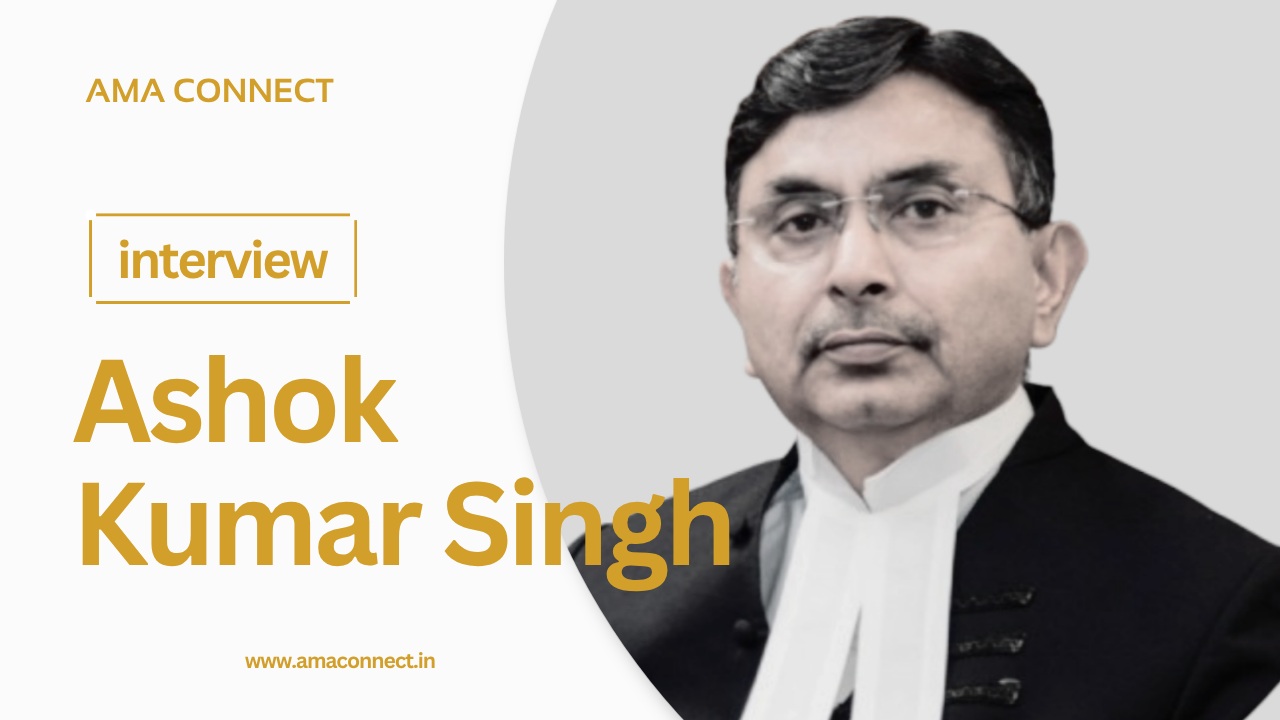
In Conversation with Ashok Kumar Singh
Senior Advocate, Supreme Court of India & Certified International Arbitrator (AIADR)
Q1. Could you take us through your journey from being a young law student to becoming a Senior Advocate, and what motivated you to build a career in litigation?
Ashok Kumar Singh:
When I started my professional journey, the legal profession was very different from what it is today. It was difficult for young lawyers to find good seniors, and there was hardly any concept of paid internships or structured training. Juniors often worked for years without any remuneration and had very limited access to files and professional opportunities.
I began my career at a time when young lawyers were expected to learn primarily through observation and hard work. Fortunately, one of my seniors recognised my potential and encouraged me to develop as a criminal lawyer. With his guidance and support, I was able to start independent practice relatively early.
Over the years, I established myself in the district courts, particularly at Tis Hazari, and gradually developed a strong practice. Looking back, the journey has been one of continuous learning, hard work and adapting to the changing expectations of the profession.
Q2. You have witnessed significant changes in the legal profession over several decades. How has the relationship between lawyers and clients evolved?
Ashok Kumar Singh:
The relationship has changed substantially. Earlier, clients primarily looked for a hardworking lawyer who would present their case properly on the basis of the facts and law. They appreciated the effort put into the case, even when the ultimate outcome was not immediately in their favour.
Today, clients have become much more relief-oriented. They want to know what practical outcome can be achieved and how quickly it can be achieved. Consequently, lawyers have also had to change their approach. The focus is no longer merely on presenting legal propositions but also on understanding the client's objectives and working towards a practical solution.
Another major change is the growing concern about delays in the judicial process. Earlier, clients were more likely to attribute delays to their lawyers. Today, they increasingly recognise that judicial delays can also arise because courts are heavily burdened with litigation.
The profession has also become more structured for young lawyers. Internships provide students with an opportunity to gain practical exposure while still in law school, and remuneration for juniors has also improved considerably compared to earlier times.
Q3. Having served as a sole arbitrator and as a member of arbitral tribunals, what qualities do you believe an effective arbitrator must possess, particularly while handling complex disputes?
Ashok Kumar Singh:
Whether a dispute is simple or complex, an arbitrator should approach every matter with the same seriousness. A complex dispute may require greater effort to identify the real controversy and determine how it can be resolved.
One of the most important qualities is the tone, tenor and temperament of the arbitrator. An arbitrator should remember that he is not a judge sitting in a traditional court. An arbitrator is essentially responsible for resolving a dispute between parties and should create an environment in which the parties have confidence in the process.
At the same time, an arbitrator must maintain discipline, particularly regarding timelines. He should understand genuine difficulties faced by parties while ensuring that unnecessary adjournments and delays are avoided.
Another important aspect is preparation. In my view, an arbitrator should familiarise himself with the pleadings and documents before the arguments begin. If the arbitrator understands the crux of the dispute at an early stage, unnecessary arguments and documents can be avoided and the matter can be resolved more efficiently.
I also believe that an arbitrator should not take on an excessive number of matters. If arbitrators are overburdened, scheduling becomes difficult and the very purpose of arbitration efficient dispute resolution is defeated.
Q4. India has significant potential to become a global arbitration hub. What, in your view, are the major challenges preventing India from becoming a preferred international arbitration destination?
Ashok Kumar Singh:
India certainly has the potential to become a major international arbitration destination. We have good infrastructure, hotels, lawyers and arbitration institutions. However, international clients continue to choose established centres such as Singapore, London and Hong Kong for a significant number of arbitrations, including disputes involving Indian parties.
One issue is that India has several arbitration institutions operating independently. What we need is greater coordination and a unified international arbitration ecosystem that can provide international parties with confidence and clarity.
Another concern relates to the appointment of arbitrators. International arbitration requires a system that inspires confidence among international users. Arbitrators should be selected based on professional expertise and experience rather than primarily on their previous judicial position.
The tone, tenor and temperament of the arbitration process also matter greatly. International users should feel that arbitration in India is professional, independent, efficient and comparable with leading international institutions.
India has the infrastructure and professional talent required to become a global arbitration hub. What is required is greater institutional coordination, professional participation and a system that inspires confidence among international parties.
Q5. What are some common mistakes that young lawyers should avoid when entering litigation, and how should they approach a client's case?
Ashok Kumar Singh:
A lawyer must always look at the case from the perspective of the client. Our responsibility is to protect the client's interests with complete dedication and to make every legitimate effort to obtain the desired relief.
However, there is an important distinction between advocacy and adjudication. When representing a client, the lawyer must advance the client's case to the best of his ability, within the law. When acting as an arbitrator or adjudicator, the approach must become completely impartial. Both sides have to be considered before arriving at a decision.
Young lawyers should therefore understand that their role changes depending on the capacity in which they are acting. As advocates, they represent a party; as arbitrators, they have a duty to ensure that justice is done between all parties.
Above all, young lawyers should avoid approaching cases mechanically. They must understand the facts, study the documents carefully and identify the real issue before beginning their arguments.
Q6. For a young lawyer aspiring to build a long-term career in litigation or arbitration, what should be prioritised during the first five to ten years legal knowledge, drafting, courtroom exposure or networking?
Ashok Kumar Singh:
In the initial years, the priority should be to learn the profession comprehensively. Networking alone cannot build a successful litigation career.
A lawyer should work on every important aspect of practice understanding facts, reading law, drafting, researching judgments, preparing briefs and appearing before courts. One cannot say, "I am good at drafting but I am not good at arguing," and expect that to be sufficient.
Young lawyers should spend time with clients, understand their instructions, prepare matters carefully and identify judgments that support their case. They should also learn how to present those authorities effectively before the court.
Over a period of five to ten years, a lawyer will naturally discover the areas in which he or she wants to specialise. Until then, it is important to gain broad exposure and develop strong fundamentals.
If I were beginning my career today, I would follow the same fundamental principle: work hard, learn every aspect of litigation and develop the ability to handle a case from beginning to end.
Q7. The requirement of three years of practice before appearing for the judicial service examination has been reduced to one year. What is your view on this change, and what advice would you give to young law students entering the profession?
Ashok Kumar Singh:
Whether the requirement is one year or three years does not make much difference if the practice is not undertaken seriously. Earlier, the three-year requirement at least provided an opportunity for a person to spend more time in court and understand the practical difficulties faced by lawyers and litigants.
Judicial service is a highly responsible profession. A judicial officer has to devote substantial time to reading files, understanding facts, examining the law and delivering reasoned judgments. It is not merely a position of status; it is a service to the people.
For young lawyers and law students, my advice is simple: hard work is the key to success. Give sufficient time to your clients. Understand their facts properly before drafting. Keep yourself updated with the latest judgments and prepare every case thoroughly.
You must enter the profession with honesty, dedication and respect for its values. There may be shortcuts that appear attractive in the beginning, but they do not provide a sustainable career. In the long run, it is only hard work, integrity and professional commitment that will help you succeed.
Give your best in court, prepare your case thoroughly, and leave the rest to God.